
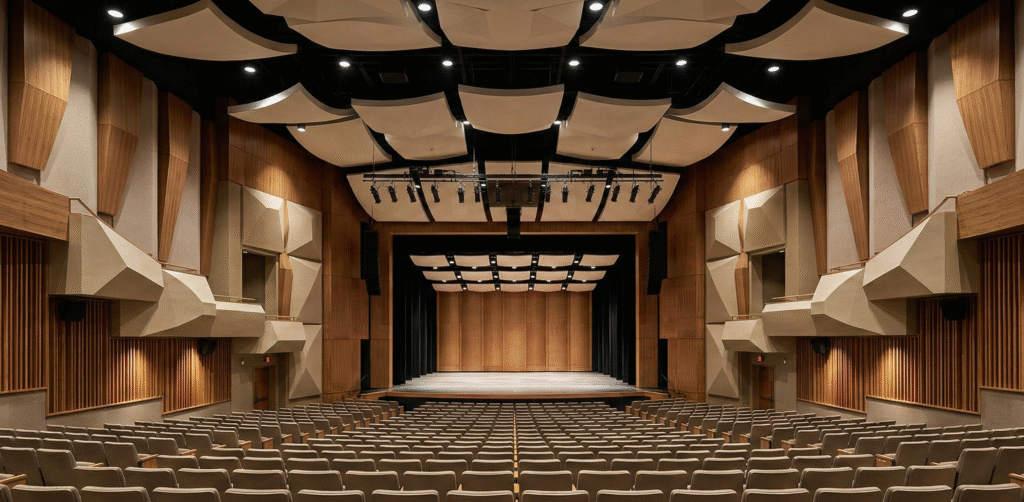
Every performance deserves to be heard perfectly. Yet countless auditoriums struggle with acoustic problems that undermine their core purpose. Performers strain to project their voices over muddy echoes. Musicians cannot hear each other clearly on stage. Audiences in rear seats miss critical dialogue while those near the front experience overwhelming volume. These acoustic failures transform what should be inspiring venues into frustrating spaces that disappoint everyone involved.
Poor auditorium acoustics damage more than just immediate performances. They harm venue reputations, reduce booking rates, and force event organizers to seek alternatives. Schools lose educational opportunities when students cannot understand lectures clearly. Cultural centers fail to attract quality performances when musicians know the venue sounds poor. The financial and cultural costs compound over time, making acoustic excellence not just desirable but essential.
This comprehensive guide explores everything you need to know about creating exceptional auditorium acoustics. Whether you are planning a new venue, renovating an existing space, or troubleshooting acoustic problems, understanding these principles transforms performance spaces from acoustic nightmares into sonic masterpieces that serve performers and audiences beautifully.
Understanding Auditorium Acoustics
Auditorium acoustics represent the science and art of controlling how sound behaves within performance spaces. When sound waves emanate from a stage, they travel outward in all directions, encountering walls, ceilings, floors, and objects throughout the venue. These surfaces either reflect sound back into the space, absorb it, or scatter it in multiple directions. The complex interaction of these reflections determines whether audiences experience clear, intelligible sound or confusing acoustic chaos.
Good auditorium acoustics create an environment where every seat receives balanced, clear sound at appropriate levels. Speech remains intelligible without amplification in properly designed halls. Music maintains its dynamic range and tonal character throughout the seating area. Performers hear themselves and their fellow musicians accurately, enabling confident, connected performances that engage audiences deeply.
Poor acoustics manifest in multiple ways. Echo obscures consonants in speech, making dialogue incomprehensible. Excessive reverberation blurs musical passages into muddy confusion. Uneven sound distribution creates dead spots where some audience members hear poorly while others experience excessive volume. Background noise from mechanical systems or external sources masks quiet passages and destroys the intimacy necessary for powerful performances.
The distinction between excellent and mediocre auditorium acoustics often determines a venue’s success or failure. Performers actively seek venues known for supportive acoustics and avoid those with poor reputations. Audiences return to spaces where they consistently enjoy clear, immersive sound experiences. Understanding acoustic principles enables informed decisions that create venues worthy of the performances they host.
Common Acoustic Problems in Auditoriums
Echo and Flutter Echo
Echo plagues auditoriums when sound reflects off distant surfaces and returns to listeners as distinct repetitions. Large back walls positioned far from the stage create the most problematic echoes. Sound travels to the rear wall and bounces back with sufficient delay that listeners perceive it as a separate event rather than blended reinforcement. This delayed reflection confuses speech intelligibility and creates disturbing artifacts in music.
Flutter echo occurs between parallel reflective surfaces like side walls or floor and ceiling. A sharp sound like a handclap triggers rapidly repeating echoes that flutter audibly. This metallic ringing effect colors all sounds in the space, adding unnatural character that degrades acoustic quality. Even audiences unfamiliar with acoustic terminology recognize that something sounds wrong when flutter echo dominates a venue.
Curved rear walls focus reflected sound into concentrated hot spots, creating extremely loud areas surrounded by relatively quiet zones. This focusing effect ruins uniform sound distribution and creates dramatically different experiences depending on seating location. Similarly, domed ceilings gather sound at focal points, producing acoustic disasters despite their architectural appeal.
Excessive Reverberation
Reverberation represents the persistence of sound after the source stops. In auditoriums, reflected sound bouncing repeatedly between surfaces creates a reverberant tail that extends beyond the original sound. Moderate reverberation enriches music, adding warmth and fullness that audiences find pleasing. Excessive reverberation, however, becomes problematic when it obscures detail and clarity.
Speech venues require relatively short reverberation times, typically between 0.8 and 1.2 seconds. Longer reverberation causes successive syllables to overlap, destroying consonant clarity and making speech difficult to understand. Audiences strain to follow dialogue, eventually tuning out or becoming frustrated with the poor listening experience.
Music venues tolerate and even benefit from longer reverberation, with concert halls often designed for 1.5 to 2.5 seconds. However, when reverberation exceeds appropriate levels for the programming, musical passages blur together. Fast passages become incomprehensible. Dynamic contrasts flatten as quiet notes ring longer than intended. The careful work of composers and performers gets lost in acoustic confusion.
Different areas within auditoriums can exhibit different reverberation characteristics. Balconies often suffer from excessive reverberance when not properly treated. Areas under balconies may sound unnaturally dead compared to the main floor. Achieving consistent reverberation throughout the seating area requires careful planning and strategic treatment placement.
Dead Spots and Hot Spots
Uneven sound distribution creates dramatically different experiences for audience members depending on their seating location. Dead spots occur when destructive interference between direct and reflected sound cancels certain frequencies. Audience members in these locations hear muffled, weak sound that lacks presence and clarity. They feel disconnected from performances despite being physically present.
Hot spots concentrate sound energy through focusing reflections or constructive interference. These areas experience uncomfortably loud sound that fatigues listeners and masks subtle nuances in performances. The imbalance between dead and hot spots within a single venue creates frustration as audiences realize seating location dramatically affects their experience.
Poor sound distribution often results from inadequate attention to reflection patterns during design. Reflective surfaces positioned to reinforce sound in some areas inevitably create shadows elsewhere. Balcony overhangs block sound from reaching seats underneath, creating particularly problematic dead zones. Solving distribution problems requires understanding how sound radiates from the stage and strategically managing reflections to serve all seating areas equally.
Background Noise Intrusion
Background noise from HVAC systems, traffic, adjacent spaces, and mechanical equipment masks performances and destroys the quiet necessary for dynamic range. When background noise levels run high, quiet passages disappear entirely. Performers must increase volume to overcome the noise floor, reducing available dynamic range and forcing louder, less nuanced performances.
Air handling systems contribute significantly to auditorium background noise. High velocity air rushing through undersized ducts creates broadband noise. Unlined ductwork allows mechanical equipment noise to propagate throughout the building. Poorly located diffusers aim noise directly at audiences. The cumulative effect raises background noise to levels that compromise acoustic quality severely.
External noise from traffic, nearby classrooms, or mechanical spaces penetrates through inadequate sound isolation. Even excellent internal acoustics fail when external noise intrudes constantly. Recording and broadcast venues face particularly stringent background noise requirements since microphones capture every sound, making problems obvious in recordings that audiences might tolerate during live performances.
Key Elements of Good Auditorium Acoustics
Room Geometry and Shape
Room shape fundamentally determines acoustic behavior in ways that treatment cannot overcome. Rectangular shoebox shapes with length roughly twice the width provide excellent acoustics for music. Sound reflects predictably off side walls, providing beneficial lateral reflections that create spaciousness and envelopment. Appropriate proportions prevent problematic resonances that color sound unnaturally.
Fan-shaped auditoriums widen toward the rear, accommodating more seats within a given distance from the stage. This geometry works well for speech venues where direct sound dominates and minimal reverberation is desired. However, widening side walls reduce beneficial lateral reflections for music, potentially creating less satisfying acoustic experiences for orchestral performances.
Ceiling height profoundly impacts acoustics. Low ceilings create smaller room volumes with shorter reverberation times suitable for speech but limiting for music. High ceilings increase room volume, extending reverberation and creating spaciousness. However, excessively high ceilings position overhead reflections too far from audiences, reducing their beneficial contribution. Optimal ceiling heights balance volume requirements with reflection timing.
Avoiding parallel walls eliminates flutter echo and standing wave resonances. Splaying side walls slightly or angling them prevents direct sound reflection paths that create problematic acoustic artifacts. Similarly, avoiding perfectly parallel floor and ceiling relationships through raked seating or angled ceiling sections improves overall acoustic behavior significantly.
Surface Materials and Treatment
Surface materials determine whether auditoriums exhibit appropriate balance between sound absorption and reflection. Hard surfaces like concrete, plaster, and wood reflect sound efficiently, maintaining energy levels and extending reverberation. Soft, porous materials like fabric, acoustic panels, and carpet absorb sound, reducing reverberation and controlling acoustic energy.
Strategic placement of reflective surfaces near the stage directs early reflections toward audiences, reinforcing direct sound and improving clarity. Side walls angled to reflect sound across the seating area create beneficial lateral reflections that enhance spatial impression. Overhead reflectors suspended above the stage project sound outward, particularly helping rear seating areas receive adequate levels.
Absorptive treatment controls excessive reverberation and eliminates problematic echoes. Rear walls require substantial absorption to prevent strong delayed reflections that create echo. Upper side walls benefit from absorption that prevents late reflections from degrading clarity. Ceiling areas distant from the stage need absorption to control reverberant buildup without removing beneficial early reflections.
Acoustic panels provide targeted absorption exactly where needed. Wall mounted panels treat specific problem areas without over damping the entire space. Ceiling clouds suspend in strategic locations, absorbing overhead reflections while allowing beneficial floor reflections. Panel thickness and density determine which frequencies receive absorption, enabling precise acoustic tuning across the frequency spectrum.
Reverberation Time Optimization
Reverberation time, measured as RT60, quantifies how long sound persists after stopping. This single measurement significantly affects perceived acoustic quality. Lecture halls and theaters emphasizing speech clarity need reverberation times between 0.8 and 1.2 seconds at mid frequencies. This relatively dry acoustic allows consonants to remain clear and successive words to stay distinct.
Concert halls designed primarily for orchestral music benefit from longer reverberation times, typically 1.5 to 2.5 seconds depending on repertoire. Romantic period orchestral music sounds most appealing with reverberation around 2.0 seconds, providing warmth and blend. Chamber music performs better in slightly drier acoustics around 1.5 seconds. Opera houses split the difference, requiring enough reverberation for orchestral richness while maintaining vocal intelligibility.
Multipurpose auditoriums serving both speech and music face challenging compromises. Reverberation times around 1.5 seconds provide reasonable performance for both uses without excelling at either. Variable acoustic systems allow venues to adjust reverberation for different events, providing optimal conditions whether hosting lectures, drama, or concerts.
Frequency dependent reverberation matters as much as overall time. Low frequencies naturally reverberate longer in most spaces, creating boomy, muddy sound if not controlled. Achieving relatively flat reverberation across frequencies requires careful treatment selection. Bass traps in corners absorb low frequencies. Thicker panels handle mid bass. Thinner treatments control mid and high frequencies precisely.
Sound Diffusion
Diffusion scatters sound in multiple directions rather than creating specular reflections like mirrors. Properly diffusing surfaces prevent harsh echoes while maintaining acoustic energy and liveliness. Rear walls benefit enormously from diffusion rather than pure absorption. Diffusers scatter late arriving sound, preventing echo without creating dead acoustic character.
Side walls near the stage gain musicality from diffusion. Rather than creating single strong reflections, diffusers create multiple weaker reflections arriving from slightly different directions. This envelopment enhances spatial impression, making music sound more immersive and engaging. Performers benefit from diffusion that provides acoustic feedback without creating problematic reflections.
Ceiling areas can incorporate diffusion that prevents flutter echo between floor and ceiling while maintaining acoustic presence. Coffered ceilings naturally provide some diffusion through their geometry. Purpose built diffusers using mathematical sequences create precisely controlled scattering that improves overall acoustic quality without requiring excessive absorption.
Balancing diffusion with absorption creates liveliness and clarity simultaneously. Spaces with only absorption sound dead and uninspiring. Spaces with only diffusion may still suffer from excessive reverberation. The optimal combination provides early reflections for reinforcement and clarity, diffusion for spaciousness and envelopment, and absorption to control reverberation and prevent echo.
Soundproofing Solutions for Auditoriums
Isolating from External Noise
Building envelope soundproofing prevents external noise from intruding into performance spaces. Heavy wall construction with multiple layers of gypsum board, resilient channels, and insulation blocks airborne sound transmission. The mass of multiple material layers resists vibration from sound pressure. Decoupling through resilient mounting breaks direct structural connections that transmit vibration.
Windows represent weak points in sound isolation. Single pane windows offer virtually no sound blocking capability. Double or triple glazed windows with substantial air gaps between panes dramatically improve isolation. Laminated glass with acoustic interlayers provides even better performance. Venues requiring serious isolation often eliminate windows entirely or position them away from critical listening areas.
Doors require specialized acoustic seals and solid core construction. Standard doors with gaps around all edges leak sound freely, undermining wall isolation. Acoustic doors with compression seals around the perimeter and automatic door bottoms that engage when closed provide substantially improved performance. Double door entries with sound locks create airlocks that further enhance isolation.
Floor structures require attention in multi-story buildings. Impact noise from footfalls in spaces above auditoriums disturbs performances. Floating floor systems decouple finished floors from structural slabs, preventing vibration transmission. Resilient underlayments provide simpler solutions for moderate isolation needs. Carpeting over padding provides basic but limited impact noise reduction.
Internal Noise Control
HVAC systems generate significant noise that requires comprehensive control strategies. Locating mechanical equipment in separate rooms away from performance spaces provides initial isolation. Resilient mounting of equipment prevents vibration from transmitting through building structures. Flexible connections between equipment and ductwork prevent vibration transmission into the distribution system.
Ductwork requires lining with absorptive materials that capture noise before it propagates to occupied spaces. Fiberglass duct liner or board provides effective absorption across broad frequency ranges. Duct silencers containing baffles lined with absorptive materials provide additional noise reduction where needed. Properly sized ducts with low air velocity reduce turbulent noise generation at the source.
Diffusers and grilles require careful selection and placement. High velocity throws create noise directly at audience locations. Low velocity diffusers positioned away from critical listening zones minimize HVAC related noise. Acoustically rated grilles with backing chambers provide additional noise reduction beyond duct treatments.
Projection booths, control rooms, and backstage areas need acoustic separation from performance spaces. Sound locks with double doors prevent noise from technical areas from bleeding into audience zones during performances. Observation windows require double glazing with substantial separation between panes. HVAC for these support spaces requires independent systems that do not share ductwork with performance areas.
Mechanical System Considerations
Duct silencers reduce noise transmission through air handling systems dramatically. Absorptive baffles force air through narrow passages lined with sound absorbing materials. The increased surface area to volume ratio provides substantial noise reduction across broad frequency ranges. Critical silencers achieve 20 to 30 decibel insertion loss, making them essential for quiet venues.
Low velocity air distribution minimizes turbulence that generates noise. Designing ductwork with cross sectional areas that maintain velocities below 1500 feet per minute reduces noise generation significantly. This approach requires larger ducts than conventional design but provides inherently quieter operation that requires less corrective treatment.
Vibration isolation mounting for air handling units, pumps, and other mechanical equipment prevents structure borne noise transmission. Spring isolators, rubber mounts, or combination systems decouple equipment from building structures. Proper isolator selection based on equipment weight and operating frequencies ensures effective vibration control. Flexible connections prevent bridging that defeats isolation systems.
Variable frequency drives for fans and pumps reduce operational noise significantly compared to constant speed operation. Operating equipment at reduced speeds during performances lowers noise output when quiet matters most. Automatic control systems adjust HVAC operation based on occupancy and scheduling, providing full ventilation when needed and minimal noise during performances.
Treatment Solutions and Technologies
Wall Treatment Options
Fabric wrapped acoustic panels provide excellent absorption while allowing aesthetic customization. Rigid fiberglass or mineral wool cores provide the absorption, while fabric faces protect the cores and contribute to visual design. Panels mount directly to walls using impaling clips or Z clips, creating clean installations without visible fasteners. Custom fabric selection allows matching venue color schemes and creating visual interest through pattern and texture.
Perforated wood panels combine acoustic function with architectural beauty. Holes or slots in wood facings allow sound to enter backing cavities containing absorptive materials. The wood provides attractive, durable surfaces appropriate for high end venues while the hidden absorption controls acoustics. Panel patterns create visual rhythm that enhances architectural character while serving acoustic purposes.
Functional decorative treatments integrate acoustics into architectural elements. Fabric stretched across frames creates sculptural wall features that absorb sound. Acoustic plaster provides seamless absorptive surfaces that maintain architectural purity. Three dimensional surface textures combine diffusion with controlled absorption, addressing multiple acoustic needs simultaneously.
Coverage percentages determine treatment effectiveness. Rear walls typically require 60 to 80 percent coverage to eliminate echo. Upper side walls benefit from 40 to 60 percent coverage controlling late reflections. Lower side walls near the stage remain mostly reflective to provide early reinforcement. Strategic placement matters more than total quantity, making professional design essential for optimal results.
Ceiling Treatment Strategies
Cloud panels suspend horizontally from ceilings, providing absorption while maintaining architectural openness. Individual panels treat specific zones without covering entire ceilings. This targeted approach controls reverberation where needed while preserving beneficial reflections from untreated areas. Clouds work particularly well in spaces with exposed structure where direct ceiling mounting proves impractical.
Baffles hang vertically from ceilings, presenting edge absorption in addition to face absorption. This orientation provides excellent absorption efficiency per square foot of material. Baffles create visual interest through their three dimensional presence while serving acoustic functions. Arranging baffles in patterns creates architectural features that define spaces while controlling sound.
Coffered ceilings with absorption incorporate acoustic treatment into structural elements. Recessed areas between beams contain absorptive materials that control ceiling reflections without compromising architectural expression. This approach works beautifully in traditional auditorium designs where exposed treatment panels seem inappropriate aesthetically.
Reflector panels suspended over stages direct sound outward toward audiences rather than absorbing it. These hard surfaced panels positioned strategically above performing areas ensure rear seating receives adequate sound levels. Adjustable reflectors allow optimization for different performance types and ensemble sizes, providing acoustic flexibility without permanent modifications.
Balancing absorption and reflection overhead requires understanding how sound propagates through spaces. Early ceiling reflections near the stage provide beneficial reinforcement. Later reflections from distant ceiling areas contribute to reverberation more than clarity. Treating rear ceiling zones while leaving front areas reflective optimizes both early sound reinforcement and reverberation control.
Seating Area Acoustics
Upholstered seating provides substantial sound absorption whether occupied or empty. This consistency ensures rehearsal acoustics closely match performance conditions, allowing accurate acoustic assessment and adjustment. Heavily upholstered seats absorb more sound, potentially overdamping small venues. Moderately upholstered seats provide absorption without excessive damping, working well in most applications.
Hard seating changes acoustic dramatically between empty and occupied conditions. Empty hard seats reflect sound, creating relatively live acoustics. Occupied seats absorb sound through audience bodies and clothing, substantially reducing reverberation. This variability complicates acoustic design and makes empty hall rehearsals misleading predictors of actual performance acoustics.
Under balcony areas require special attention to prevent acoustic dead zones. Balconies block direct sound from the stage, leaving under balcony seats dependent on reflected sound. Low ceilings under balconies trap sound, creating excessive reverberation isolated from the main hall. Absorptive treatment on under balcony ceilings controls local reverberation. Reflective panels angled to direct sound into under balcony areas improve coverage and connection to the main acoustic space.
Risers and tiered seating improve sight lines while benefiting acoustics. Elevating rear seats improves direct sound paths from the stage, reducing dependence on reflections. Stepped seating sections create surface irregularities that scatter sound beneficially. The acoustic advantages of proper sightlines reinforce the importance of adequate rake in auditorium seating design.
Stage and Performance Area
Stage shells for orchestral performances create acoustically supportive environments for musicians. Overhead and rear panels reflect sound back to performers, enabling them to hear themselves and their colleagues clearly. Adjustable shells allow optimization for different ensemble sizes. Portable shells provide acoustic support in multipurpose venues that host varied events.
Overhead reflectors suspended above orchestras project sound outward to audiences while providing valuable feedback to performers. Reflector angle and position critically affect both stage acoustic support and audience coverage. Computer modeling optimizes reflector geometry during design. Adjustable systems provide tuning capability after construction.
Side wall treatments near stages balance ensemble hearing with overall hall acoustics. Excessive reflection creates overly loud stage environments that fatigue performers. Insufficient reflection prevents musicians from hearing colleagues, degrading ensemble cohesion. Controlled reflection through angled panels or partial absorption creates supportive conditions without overwhelming stage acoustics.
Floor surfaces affect performer comfort and acoustic contribution. Hard floors reflect sound upward, providing reinforcement particularly valuable for low frequencies. Carpeted floors absorb sound, reducing stage volume but potentially improving clarity. Drama stages often use carpeted or resilient floors for quiet movement. Music stages favor hard surfaces for acoustic reflection and physical durability.
Variable Acoustics Systems
Retractable banners and curtains provide simple variable absorption. Deployed banners add absorption, reducing reverberation for speech events. Retracted banners reveal reflective surfaces, extending reverberation for music. Manual or motorized operation allows adjustment between events. This simple technology provides meaningful acoustic variation at moderate cost.
Rotating wall panels incorporate absorptive materials on one face and reflective surfaces on the opposite face. Rotating panels changes room acoustics substantially. Multiple panel sections allow partial adjustment, providing intermediate acoustic conditions. Motorized rotation enables remote control adjustment, allowing real time tuning during rehearsals.
Motorized ceiling elements move vertically or rotate to expose different surface treatments. Lowered position may present absorption while raised position reveals reflection. Alternatively, tilting panels adjust reflection angles, redirecting sound to different zones. These sophisticated systems provide maximum acoustic flexibility at premium cost justified in flagship performance venues.
Adjusting venue acoustics for different events optimizes each performance type. Drama productions benefit from relatively dry acoustics that emphasize speech clarity and intimate connection. Orchestral concerts need longer reverberation that creates warmth and blend. Amplified performances work best in dead acoustics that prevent feedback and allow sound system dominance. Variable systems accommodate these diverse needs within single venues, maximizing utilization and revenue potential.
Acoustic Design Process
Professional Assessment Phase
Acoustic measurements quantify existing conditions and identify specific problems requiring treatment. Sound level measurements establish background noise baselines. Reverberation time measurements characterize sound decay across frequency bands. Frequency response measurements reveal resonances and anomalies. Objective data guides treatment design and provides baselines for verifying improvements.
Computer modeling simulates acoustic behavior before construction, allowing virtual experimentation impossible with physical spaces. Ray tracing software predicts reflection patterns, identifying problematic echoes and inadequate coverage areas. Statistical models estimate reverberation times based on surface materials and room geometry. Modeling reduces design risk and optimizes treatment placement before committing resources.
Identifying specific problem frequencies focuses treatment efforts efficiently. Mid frequency reverberation often differs significantly from bass behavior. Certain frequencies may resonate problematically while others behave well. Frequency specific treatment addresses actual problems rather than applying generic solutions that may miss critical issues.
Usage requirements and priorities determine design direction. Venues primarily hosting speech optimize differently than music halls. Multipurpose facilities balance competing demands through compromise or variable systems. Recording venues face stringent requirements impossible to achieve in general use spaces. Clear priority definition ensures design serves actual needs rather than theoretical ideals.
Design and Specification
Custom solutions for unique spaces deliver superior results compared to generic approaches. Every auditorium presents specific challenges requiring tailored responses. Computer modeling informs treatment placement and specification. Mockups verify appearance and performance before full implementation. Custom design optimizes acoustic and aesthetic integration simultaneously.
Material selection balances acoustic performance, durability, maintenance, and cost. Acoustic performance specifications ensure materials meet sound absorption or diffusion requirements. Fire ratings satisfy code compliance. Cleanability affects long term appearance and maintenance costs. Balancing these factors requires experience and understanding of material properties and building requirements.
Integration with architectural vision ensures acoustic treatments enhance rather than compromise design intent. Collaborative design processes engage architects, acousticians, and clients in developing solutions that satisfy all stakeholders. Acoustic elements become architectural features rather than applied corrections, creating cohesive designs where form and function unite beautifully.
Budget optimization strategies maximize acoustic performance within financial constraints. Phased implementation addresses critical problems first while planning future improvements. Strategic treatment placement concentrates resources where they provide maximum benefit. Value engineering identifies cost effective alternatives that maintain performance. Professional design ensures budgets deliver actual results rather than wasting resources on ineffective approaches.
Installation Considerations
Timing with construction schedules ensures acoustic treatments install at appropriate project phases. Structural treatments occur during shell construction. Finish treatments follow interior completion but precede final cleaning. Coordination prevents delays and rework. Experienced contractors understand sequencing and coordinate with other trades effectively.
Minimal disruption to existing venues requires careful planning and execution. Phased installation allows portions of venues to remain operational during treatment. Off season scheduling concentrates work during periods of minimal programming. Rapid installation techniques reduce closure duration. Professional project management balances acoustic goals with operational realities.
Quality control and testing verify installation meets specifications and performance expectations. Field measurements confirm predicted acoustic behavior. Visual inspection ensures proper installation and finish quality. Commissioning processes verify variable systems operate correctly. Testing identifies problems while correction remains simple rather than discovering issues after project completion.
Compliance with fire and safety codes ensures treatments do not compromise building safety. Flame spread and smoke development ratings satisfy code requirements for interior finishes. Exit path maintenance preserves required egress. Seismic bracing prevents treatments from becoming hazards during earthquakes. Professional specification includes appropriate materials and installation methods that satisfy all applicable codes.
Case Studies and Real World Examples
Speech Focused Auditorium Transformation
A university lecture hall seating 400 students suffered from severe echo and excessive reverberation that made lectures nearly incomprehensible beyond the front rows. Students avoided the hall despite its convenient location, forcing classes into smaller rooms that could not accommodate enrollment.
Acoustic assessment revealed reverberation time exceeding 3.5 seconds at mid frequencies, more than double the appropriate level for speech. The large flat rear wall created strong echo arriving 250 milliseconds after direct sound, long enough to register as distinct repetition. Parallel side walls exhibited flutter echo audible from handclaps.
Treatment installed acoustic panels covering 75 percent of the rear wall, completely eliminating echo. Side wall panels totaling 40 percent coverage controlled reverberation and eliminated flutter. Ceiling clouds over the rear third absorbed overhead reflections. The comprehensive treatment reduced reverberation to 1.1 seconds while maintaining adequate acoustic presence.
Speech intelligibility scores measured by Speech Transmission Index improved from 0.42 (poor) to 0.78 (good), quantifying the dramatic subjective improvement. Student surveys showed 94 percent agreement that acoustic improvements made lectures easier to follow. Class enrollment recovered, and the hall now operates at full capacity.
Music Hall Acoustic Optimization
A community performing arts center designed for theatrical productions struggled when hosting orchestral concerts. Musicians complained of inability to hear colleagues. Audiences reported uneven sound distribution with weak coverage in rear seating. The hall’s 1.2 second reverberation time suited drama but left orchestral music sounding thin and dry.
Variable acoustic systems provided the solution. Retractable banners deployed for drama presentations added 450 square meters of absorption. When retracted for concerts, the banners revealed reflective surfaces, extending reverberation to 1.8 seconds. Rotating side wall panels provided additional variable absorption, allowing fine tuning between events.
Suspended overhead reflectors above the orchestra improved projection to rear seating and provided acoustic feedback to performers. The reflector system included adjustable panels allowing optimization for different ensemble sizes. Full orchestra configurations used maximum reflection while chamber groups benefited from reduced panel deployment.
Post renovation measurements confirmed 1.8 second reverberation for concerts and 1.1 seconds for drama. Musician surveys showed unanimous agreement that stage acoustics improved significantly. Audience feedback indicated substantially improved satisfaction with orchestral performances. The hall now attracts regional orchestras previously unwilling to perform in the venue.
Multipurpose Venue With Comprehensive Treatment
A high school auditorium hosting assemblies, theatrical productions, concerts, and graduation ceremonies required acoustic flexibility serving diverse programming. Original construction provided minimal acoustic consideration, resulting in 2.8 second reverberation and severe echo that rendered the space nearly unusable for any purpose.
Comprehensive acoustic treatment addressed the challenging multipurpose requirements. Rear wall absorption eliminated echo completely. Side wall treatment combined absorption and diffusion, controlling reverberation while maintaining liveliness. Ceiling clouds provided overhead absorption without creating dead acoustic character. Total treatment reduced reverberation to 1.6 seconds, a compromise between speech and music requirements that proved acceptable for both.
The addition of a portable orchestra shell for concert performances provided musicians with acoustic support despite the compromise hall reverberation. The shell’s reflective surfaces created a more reverberant environment on stage while leaving house acoustics unchanged. This allowed the hall to serve orchestral needs reasonably well without compromising speech intelligibility for other uses.
Measurable improvements included reverberation reduction from 2.8 to 1.6 seconds and background noise reduction from NC 40 to NC 25 through HVAC improvements. User satisfaction increased dramatically across all programming types. The venue now hosts district wide events previously held elsewhere, validating the comprehensive treatment approach for multipurpose facilities facing budget constraints that preclude variable systems.
Measuring Auditorium Acoustics Success
Objective Metrics
Reverberation time measurements provide fundamental acoustic characterization. RT60 values at octave band frequencies from 125 Hz to 4000 Hz describe how quickly sound decays across the spectrum. Measurements throughout the seating area reveal spatial uniformity. Comparing measured values to targets establishes whether design goals were achieved. Most venues aim for relatively flat RT60 across frequencies, though some bass rise is acceptable and often unavoidable.
Speech Transmission Index quantifies speech intelligibility objectively. STI measurements range from 0 (completely unintelligible) to 1.0 (perfect intelligibility). Values above 0.75 indicate excellent speech clarity. Values between 0.60 and 0.75 represent good performance. Below 0.60 indicates problematic conditions requiring improvement. STI measurements throughout seating areas identify zones with inadequate intelligibility requiring targeted treatment.
Sound level distribution mapping ensures even coverage throughout audience areas. Measurements at multiple locations reveal whether all seats receive adequate levels. Level variations exceeding 6 dB indicate problems requiring attention. Mapping identifies dead spots needing reflection reinforcement and hot spots requiring absorption or diffusion to reduce excessive levels.
Background noise measurements establish whether mechanical systems and external sources intrude problematically. Noise Criteria or Noise Rating curves characterize noise spectra. Most auditoriums target NC 25 to NC 30 for excellent conditions. Recording venues require NC 20 or lower. Measurements identify specific noise sources requiring treatment, focusing remediation efforts efficiently.
Subjective Evaluation
Performer feedback from stage provides critical information about acoustic support and stage conditions. Musicians must hear themselves and colleagues clearly to perform effectively. Excessive stage volume fatigues performers and encourages playing louder, degrading musical balance. Insufficient reflection prevents ensemble cohesion and accurate pitch. Performer surveys and interviews reveal whether stage acoustics support excellent performance.
Audience surveys capture user experience data that measurements alone cannot provide. Questions about sound clarity, volume adequacy, and overall satisfaction complement objective measurements. Response patterns identify problem areas and validate successful treatments. Longitudinal surveys tracking satisfaction over time demonstrate sustained performance and identify degradation requiring maintenance attention.
Critical listening by experienced acousticians provides expert evaluation informed by extensive venue experience. Acousticians identify subtle problems and compare performance to benchmark halls. Professional assessment reveals whether venues meet standards appropriate to their purposes. Expert listening informs refinement recommendations that optimize acoustic quality.
Comparing to benchmark venues establishes whether acoustic quality meets competitive standards. Performer and audience expectations derive from experiences in other venues. Meeting or exceeding the quality of respected comparable halls ensures competitive positioning. Benchmark comparisons guide design targets and validate achieved results against realistic standards.
Investment and Returns
Cost Factors
Assessment and design fees typically represent 5 to 15 percent of total acoustic treatment costs. Professional design ensures effective treatment while avoiding wasteful approaches. Computer modeling, measurements, and specifications provide the foundation for successful implementations. Design investment pays dividends through optimized solutions and avoided mistakes.
Material and installation costs vary widely based on treatment type and project scope. Simple fabric wrapped panels cost moderately per square meter installed. Custom architectural treatments command premium pricing. Variable acoustic systems represent substantial investment justified only in certain applications. Realistic budget development requires professional cost estimating based on specific project requirements.
Renovation projects often cost more than new construction for equivalent acoustic quality. Working around existing conditions, protecting finishes, and accommodating ongoing operations increases labor costs. Limited access and scheduling constraints extend project duration. However, renovation costs compare favorably to building replacement, making acoustic improvement highly cost effective for existing venues.
New construction provides opportunities for cost effective acoustic optimization. Incorporating proper geometry, appropriate structural isolation, and correct material selection during initial construction costs substantially less than correcting problems after completion. Early acoustician involvement during design enables integrated solutions impossible to achieve through renovation.
Value Delivered
Increased venue rental rates justify acoustic investment through higher revenue. Superior acoustics allow premium pricing that better venues command. Performers actively seek quality venues and accept higher costs for better conditions. Market positioning as an acoustic excellence venue differentiates properties in competitive rental markets.
Higher booking frequency results from enhanced reputation and word of mouth recommendations. Satisfied performers return and recommend venues to colleagues. Successful events generate repeat business. Improved acoustics transform venues from last resort options into preferred destinations that maintain full calendars year round.
Enhanced reputation and positive reviews create lasting value difficult to quantify but undeniably real. Online reviews and social media posts reach wide audiences. Positive acoustic reputation attracts quality programming that further enhances venue standing. Negative acoustic reputation proves nearly impossible to overcome without physical improvements addressing problems.
Performer and audience loyalty develops when venues consistently deliver excellent experiences. Regular users appreciate quality and become advocates. Educational venues gain enrollment when students prefer auditoriums with excellent acoustics. Cultural venues build subscriber bases and donor support through exceptional presentations enabled by superior acoustics.
Long term durability of quality treatments provides decades of service without replacement. Proper acoustic materials resist degradation, maintaining performance and appearance. Initial investment amortizes over 20 to 30 years, making annual costs modest. Maintenance requirements remain minimal for properly specified and installed treatments.
Maintenance and Long Term Care
Periodic acoustic testing verifies continued performance and identifies degradation before it becomes severe. Reverberation time measurements every 5 to 10 years establish performance trends. Comparison with original measurements reveals changes requiring investigation. Professional testing costs minimally compared to treatment investment and ensures sustained acoustic quality.
Cleaning and care of acoustic treatments extends service life and maintains appearance. Fabric wrapped panels require periodic vacuuming to remove dust accumulation. Perforated wood panels need occasional cleaning to prevent clogging that reduces acoustic effectiveness. Manufacturer recommendations specify appropriate cleaning methods and frequencies for specific products.
Adjusting variable systems as needed maintains optimal acoustic conditions. Mechanical components require periodic inspection and lubrication. Control systems may need recalibration after years of service. Regular preventive maintenance prevents failures and extends system life substantially.
Addressing wear and degradation prevents small problems from becoming major issues. Damaged panels replaced immediately maintain uniform appearance and acoustic performance. Seal repairs preserve sound isolation effectiveness. Proactive maintenance costs far less than deferred repair that allows damage to spread.
Considering acoustic updates makes sense when venue use changes significantly or acoustic technology advances. Renovations provide opportunities to reassess acoustic needs and incorporate improvements. Modern materials and methods may deliver better performance than treatments installed decades earlier. Strategic updates maintain competitive acoustic quality over building lifetimes spanning many decades.
Conclusion
Exceptional auditorium acoustics transform performance spaces from merely adequate to truly inspiring. The principles and strategies outlined in this comprehensive guide enable informed decision making about acoustic treatment, whether planning new construction or improving existing venues. From understanding fundamental acoustic behavior to implementing sophisticated variable systems, creating superior auditorium acoustics requires attention to numerous details that collectively determine success or failure.
Poor acoustics compromise every performance, frustrating performers who cannot hear themselves clearly and audiences struggling to understand speech or appreciate musical nuance. The financial impacts extend beyond immediate dissatisfaction, affecting venue reputation, booking rates, and ultimately property value. Investing in proper acoustic treatment delivers returns through enhanced functionality, user satisfaction, and competitive positioning that justify initial costs many times over.
Professional acoustic assessment provides the foundation for effective treatment by identifying specific problems and quantifying improvement opportunities. Generic solutions applied without understanding actual conditions waste resources while missing critical issues. Computer modeling and experienced design ensure treatments address root causes rather than symptoms, delivering maximum improvement from available budgets.
The comprehensive approach combining proper geometry, strategic material placement, effective soundproofing solutions, and appropriate reverberation control creates auditorium acoustics that serve performers and audiences beautifully. Whether optimizing for speech clarity, musical richness, or multipurpose flexibility, success requires balancing competing demands through informed design that prioritizes actual usage requirements.
Long term value from quality acoustic treatment extends decades into the future. Properly specified and installed materials maintain performance and appearance throughout building lifetimes. Minimal maintenance requirements and sustained acoustic excellence make initial investment highly cost effective compared to poor acoustics that compromise venues permanently without correction.
Transform your auditorium from an acoustic liability into an asset that attracts performers, delights audiences, and generates pride among stakeholders. Professional acoustic treatment, including solutions like Acoustic Panel by Akinco, creates venues worthy of the performances they host, ensuring every seat offers clear, balanced, immersive sound that does justice to artistic efforts and educational content. The investment in acoustic excellence pays immediate and lasting dividends through improved experiences, enhanced reputation, and operational success that positions venues competitively in demanding markets where quality determines outcomes.
Frequently Asked Questions
What is the difference between acoustics and soundproofing in auditoriums?
Acoustics refers to controlling how sound behaves within a space, managing reflections, reverberation, and distribution to create appropriate listening conditions. Soundproofing prevents sound from entering or leaving spaces, isolating venues from external noise and preventing sound leakage to adjacent areas. Both are essential but serve different purposes. A well soundproofed auditorium can still have terrible internal acoustics if reflections and reverberation are not properly managed. Conversely, excellent internal acoustics become irrelevant if external noise intrudes constantly. Comprehensive treatment addresses both acoustic quality and sound isolation simultaneously.
How much does auditorium acoustic treatment typically cost?
Costs vary enormously based on venue size, existing conditions, and treatment scope. Basic acoustic panel installation for a small 100 seat auditorium might range from $15,000 to $30,000. Medium sized 500 seat venues typically require $75,000 to $150,000 for comprehensive treatment. Large performance halls can exceed $500,000 for sophisticated solutions including variable acoustics. New construction incorporating acoustic optimization during design costs 10 to 20 percent more than standard construction but substantially less than retrofitting acoustic treatment later. Professional assessment and design fees typically add 10 to 15 percent to material and installation costs. Budget development requires specific project evaluation rather than generic estimates.
Can acoustic treatment be added to existing auditoriums without major renovation?
Yes, many effective treatments retrofit to existing venues with minimal disruption. Wall mounted acoustic panels attach directly to existing surfaces without structural modifications. Suspended ceiling clouds hang from existing structure without removing or modifying ceilings. Portable acoustic shells provide orchestra support without permanent installation. Most acoustic improvements install within days or weeks rather than months, allowing venues to continue operations during treatment. Some improvements like floating floors or decoupled walls require more invasive construction, but these represent minority of typical treatments. Professional design determines which retrofit approaches work best for specific venues and constraints.
What is the ideal reverberation time for an auditorium?
Ideal reverberation time depends entirely on primary venue usage. Lecture halls and conference facilities emphasizing speech intelligibility need short reverberation between 0.8 and 1.2 seconds at mid frequencies. Theatrical venues benefit from similar relatively dry acoustics. Concert halls designed for orchestral music typically target 1.8 to 2.2 seconds, with larger halls and romantic repertoire favoring longer times. Chamber music sounds best around 1.5 seconds. Opera houses require intermediate values balancing orchestral richness with vocal intelligibility, typically 1.4 to 1.8 seconds. Multipurpose venues compromise around 1.5 seconds, acceptable for multiple uses without excelling at any. No single reverberation time suits all purposes, making usage priorities essential for determining appropriate targets.
Do acoustic panels affect the visual appearance of auditoriums?
Modern acoustic panels integrate into architectural design rather than compromising appearance. Fabric wrapped panels accept custom fabric selections in thousands of colors and patterns, allowing coordination with any design scheme. Perforated wood panels provide natural wood beauty while serving acoustic functions. Acoustic plaster creates seamless surfaces indistinguishable from standard plaster. Panels arranged in patterns become decorative features that enhance rather than detract from appearance. Suspended clouds and baffles create three dimensional interest while serving acoustic purposes. Successful acoustic design treats materials as architectural elements rather than applied corrections, creating cohesive designs where acoustic and aesthetic goals unite. Poor acoustic design applies generic treatments without aesthetic consideration, creating industrial appearance inappropriate for public venues.
How long does acoustic treatment installation typically take?
Installation duration depends on project scope and complexity. Simple wall panel installation in a small auditorium might complete within 3 to 5 days. Medium venues requiring comprehensive wall and ceiling treatment typically need 2 to 4 weeks. Large complex projects involving variable systems and integrated architectural treatments can extend 2 to 3 months. Most installations allow continued venue operation, though some noise and access restrictions occur during active work. Scheduling around programming calendars minimizes impact. Prefabrication of custom components reduces on site time substantially. Professional contractors experienced in occupied building work coordinate activities to maintain operations while completing installations efficiently.
Will acoustic treatment help with HVAC noise in my auditorium?
Acoustic treatment provides some benefit for HVAC noise but cannot substitute for proper mechanical system design and equipment quieting. Ceiling absorption reduces sound reflecting between ceiling and floor, moderately decreasing overall levels. Wall treatment may help if supply diffusers aim at reflective surfaces that scatter noise throughout spaces. However, the most effective approach addresses noise at its source through proper equipment selection, vibration isolation, duct silencers, low velocity design, and strategic diffuser placement away from critical listening areas. Comprehensive solutions combine source control with room treatment, while expecting room treatment alone to solve significant HVAC noise problems leads to disappointment.
Can one auditorium serve both speech and musical performances effectively? Multipurpose auditoriums can serve varied uses reasonably well through careful acoustic compromise or variable acoustic systems. Fixed acoustic treatment targeting 1.4 to 1.6 seconds reverberation provides acceptable performance for both speech and music without excelling at either. This compromise works well for venues with diverse programming where optimization for single use seems inappropriate. Variable acoustic systems using retractable banners, rotating panels, or adjustable elements allow venues to optimize acoustics for different events, providing 1.0 to 1.2 seconds for speech and 1.8 to 2.0 seconds for music. Variable systems cost substantially more than fixed treatment but deliver superior performance across diverse programming, justifying their premium cost in heavily used multipurpose venues.