Finding the right acoustic treatment transforms noisy, echo filled spaces into comfortable, productive environments. Traditional solutions like fiberglass have dominated the market for decades, but they come with significant drawbacks including skin irritation, respiratory concerns, and environmental impacts. The acoustic treatment industry is experiencing a revolution with sustainable, safe, high performance materials that deliver professional results without compromising health or environmental responsibility.
Polyester fiber panels represent this modern evolution in acoustic treatment. These engineered panels combine exceptional sound absorption with safety, sustainability, and design flexibility that traditional materials cannot match. Whether you are treating a corporate office, educational facility, recording studio, or residential space, understanding polyester fiber panels enables informed decisions that create superior acoustic environments while supporting broader sustainability goals.
This comprehensive guide explores everything you need to know about polyester fiber panels. From their composition and manufacturing to performance specifications, applications, and installation methods, you will gain the knowledge necessary to confidently specify and implement these innovative acoustic solutions. Professional results are achievable when you understand the material science, application strategies, and design principles that maximize acoustic performance.
What Are Polyester Fiber Panels?
Polyester fiber panels are engineered acoustic treatments manufactured from polyester fibers compressed into rigid or semi rigid panels designed specifically for sound absorption. Unlike acoustic foam or traditional fiberglass, these panels consist of thermoplastic polyester polymer, often derived from recycled PET (polyethylene terephthalate) bottles collected through recycling programs worldwide. The transformation from discarded plastic bottles to high performance acoustic panels represents remarkable material science innovation.
The manufacturing process begins with cleaned, sorted PET bottles broken down into small flakes. These flakes undergo heating and extrusion, creating continuous polyester fibers. The fibers are then laid in random orientations and compressed under heat and pressure, forming cohesive panels without requiring chemical binders or adhesives. This thermal bonding process creates structurally sound panels that maintain their shape and performance characteristics throughout decades of service.
Physical characteristics distinguish polyester fiber panels from competing materials. The panels exhibit consistent density throughout their thickness, typically ranging from 80 to 120 kilograms per cubic meter. This uniform density ensures predictable acoustic performance across the entire panel surface. The material feels firm yet slightly flexible, allowing some conformity to mounting surfaces while resisting permanent deformation. Colors penetrate throughout the material rather than existing as surface coatings, preventing visible wear from minor surface damage.
Polyester fiber panels differ fundamentally from traditional acoustic materials in composition, safety profile, and environmental impact. Fiberglass panels contain fine glass fibers that irritate skin and respiratory systems during handling and installation. Acoustic foam, while lightweight and inexpensive initially, degrades rapidly, presents serious fire hazards, and offers limited acoustic performance. Mineral wool provides good acoustic properties but generates significant dust, poses handling challenges, and lacks the sustainability credentials of recycled polyester. These distinctions make polyester the preferred choice for modern acoustic projects prioritizing occupant health, environmental responsibility, and long term performance.
How Polyester Fiber Panels Work for Sound Absorption
Sound Absorption Mechanism
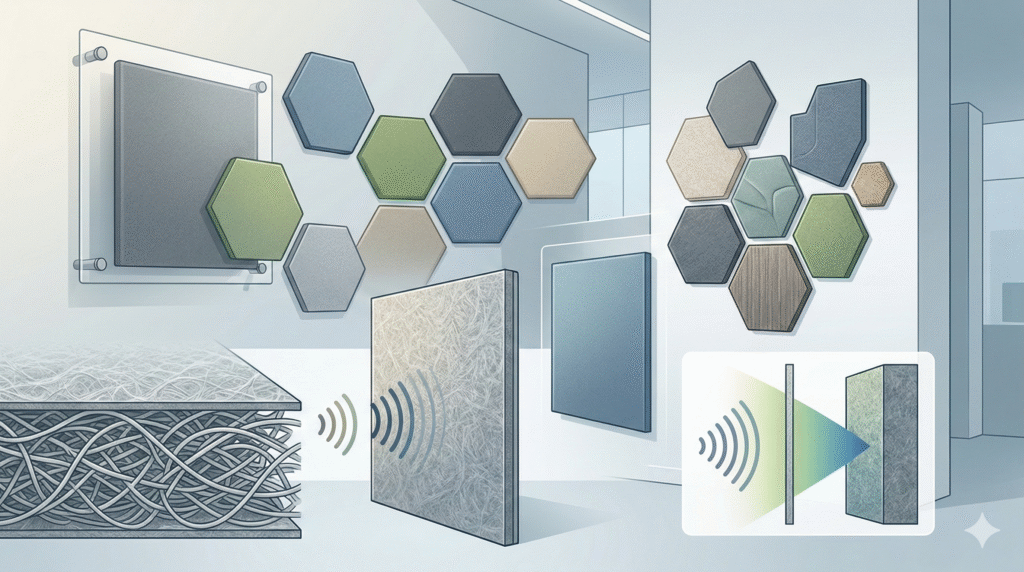
Sound absorption occurs when acoustic energy converts to other forms of energy, primarily heat, preventing sound waves from reflecting back into spaces. Polyester fiber panels accomplish this through their porous structure containing countless interconnected air spaces between individual fibers. When sound waves enter these panels, air molecules within the pores are set into motion, creating friction between moving air and fiber surfaces.
This friction converts kinetic energy from sound waves into minimal thermal energy (heat). The transformation is remarkably efficient despite the microscopic temperature increases involved. The random fiber orientation within panels ensures sound encounters resistance regardless of the angle of incidence, providing omnidirectional absorption that performs consistently throughout spaces. This characteristic makes polyester panels effective even in complex acoustic environments with sound arriving from multiple directions simultaneously.
The porous structure’s effectiveness depends on fiber density, panel thickness, and the size and distribution of air spaces between fibers. Optimal manufacturing creates panels with sufficient porosity for sound penetration while maintaining structural integrity. Too little density allows sound to pass through without adequate absorption. Excessive density prevents sound penetration, creating surface reflection rather than absorption. Quality polyester fiber panels achieve the precise balance delivering maximum acoustic performance.
Noise Reduction Coefficient (NRC) ratings quantify a material’s sound absorption capability across the speech frequency range. NRC values range from 0.00 (perfect reflection, no absorption) to 1.00 (perfect absorption, no reflection). High quality polyester fiber panels achieve NRC ratings between 0.85 and 1.00 depending on thickness and mounting method, indicating they absorb 85 to 100 percent of sound energy striking their surfaces. These exceptional ratings place polyester panels among the most effective acoustic materials available.
Performance Specifications
Sound Absorption Average (SAA) provides another performance metric similar to NRC but calculated slightly differently according to ASTM C423 testing standards. SAA values typically align closely with NRC ratings, with quality polyester panels achieving SAA values of 0.80 to 0.95. These high values confirm polyester’s effectiveness across the critical frequency ranges where human speech and most environmental noise occurs, typically 250 to 4000 Hertz.
Panel thickness profoundly impacts low frequency absorption performance. Sound waves with longer wavelengths (lower frequencies) require deeper porous materials for effective absorption. Standard 9 millimeter panels excel at mid and high frequency absorption but provide limited low frequency performance. Increasing thickness to 12 millimeters improves low frequency response moderately. Panels at 25 millimeters deliver good performance down to approximately 250 Hertz. Thick 50 millimeter panels extend effective absorption well below 200 Hertz, addressing bass frequencies that challenge thinner materials.
The relationship between thickness and frequency absorption follows physics principles where absorption depth should be approximately one quarter of the sound wavelength for optimal effectiveness. A 500 Hertz tone has a wavelength of approximately 686 millimeters, suggesting optimal absorption thickness around 170 millimeters. While impractical for wall panels, this principle explains why corner bass traps using multiple panel layers or very thick single panels outperform standard wall treatments at low frequencies.
Density variations within the 80 to 120 kilogram per cubic meter range affect absorption characteristics subtly. Lower density panels (80 to 90 kg/m³) offer slightly better high frequency absorption due to increased porosity allowing easier sound penetration. Higher density panels (100 to 120 kg/m³) improve structural rigidity and provide marginally better low frequency absorption from increased mass. Most applications benefit from medium density panels (90 to 100 kg/m³) balancing performance, durability, and cost effectiveness across the full frequency spectrum.
Key Benefits of Polyester Fiber Panels
Environmental Sustainability
Environmental sustainability distinguishes polyester fiber panels as the responsible choice for acoustic treatment. Manufacturing typically incorporates 60 to 100 percent post consumer recycled content, primarily from PET bottles diverted from landfills and oceans. A single square meter of 25 millimeter thick panel contains approximately 80 to 100 plastic bottles, giving tangible meaning to recycling programs that might otherwise seem abstract to building occupants. This recycled content dramatically reduces demand for virgin petroleum based materials.
Carbon footprint analysis reveals significant advantages compared to fiberglass production. Manufacturing fiberglass requires melting sand at temperatures exceeding 1400 degrees Celsius, consuming enormous energy. Polyester panel production operates at substantially lower temperatures, typically 200 to 300 degrees Celsius, reducing energy consumption by 40 to 60 percent per kilogram of finished product. Transportation energy also decreases due to polyester’s lower density compared to fiberglass, reducing shipping weights and associated emissions.
End of life recyclability completes polyester panels’ circular economy credentials. Unlike fiberglass which presents recycling challenges due to glass fiber contamination concerns, polyester panels can be reprocessed into new panels or other polyester products. This recyclability means panels need never enter landfills, instead continuously cycling through use, recovery, and remanufacturing. Forward thinking manufacturers are establishing take back programs facilitating this circularity.
Volatile Organic Compound (VOC) emissions from polyester panels register at zero or near zero in testing. The manufacturing process requires no formaldehyde, no chemical binders, and no toxic additives that might off gas into indoor environments. This clean composition makes polyester panels ideal for sensitive applications including schools, healthcare facilities, and residences where indoor air quality directly impacts occupant health. Third party certifications through programs like Declare labels and Health Product Declarations document these environmental and health attributes transparently.
Green building certification programs recognize polyester panels’ sustainability merits. Leadership in Energy and Environmental Design (LEED) projects can claim points for recycled content, low emitting materials, and waste reduction. BREEAM assessments similarly reward polyester panel specification. WELL Building Standard criteria for acoustic comfort and material transparency align perfectly with polyester’s performance and disclosure practices. Specifying polyester panels supports project sustainability goals while delivering required acoustic performance.
Health and Safety Advantages
Health and safety benefits make polyester fiber panels dramatically superior to traditional acoustic materials for human occupied spaces. The non toxic composition contains no substances recognized as health hazards. No formaldehyde outgassing occurs. No heavy metals contaminate the material. No carcinogenic substances present concerns. This clean material profile means extended exposure during manufacturing, installation, and decades of service presents no health risks to workers or building occupants.
Airborne particle generation, a significant concern with fiberglass and mineral wool, does not occur with polyester panels. Cutting, drilling, or sanding polyester generates no respirable fibers. Workers handling panels experience no skin irritation, no itching, and no respiratory discomfort. Installation proceeds without requiring protective equipment beyond standard construction safety gear. This ease of handling reduces installation time, lowers labor costs, and improves installer satisfaction compared to materials requiring full protective gear.
The implications for sensitive environments prove substantial. Schools benefit enormously from polyester panels because children’s developing respiratory systems face particular vulnerability to airborne irritants. Healthcare facilities appreciate polyester’s compatibility with infection control protocols and patient safety requirements. Residential applications allow homeowners to install acoustic treatment without health concerns for family members, pets, or themselves during DIY installation projects.
Fire safety performance meets or exceeds the most stringent building code requirements globally. Testing according to ASTM E84 standards typically yields Class A fire ratings, the highest classification indicating flame spread below 25 and smoke development below 450. European testing under EN 13501-1 often achieves Euroclass B-s1, d0 ratings, indicating limited combustibility, minimal smoke production, and no flaming droplets. These ratings permit unrestricted use in virtually all building types and occupancies.
Hypoallergenic properties make polyester panels appropriate even for occupants with chemical sensitivities or allergies. The material contains no known allergens, supports no mold or bacterial growth even in humid conditions, and harbors no dust mites. This biological inertness maintains indoor air quality without introducing new allergen sources, particularly valuable in healthcare settings, schools, and residences housing sensitive individuals.
Durability and Maintenance
Long term durability delivers exceptional value from polyester fiber panels. Unlike acoustic foam which deteriorates within 3 to 5 years from UV exposure, oxidation, and physical breakdown, polyester panels maintain structural integrity and acoustic performance for 20 years or more under normal indoor conditions. This longevity means installation costs amortize over decades rather than requiring replacement cycles every few years, dramatically improving total cost of ownership.
Resistance to sagging distinguishes polyester from fiberglass panels which may droop or deform over time, especially in high humidity environments. Polyester’s thermoplastic nature and thermal bonding manufacturing process create stable structures that maintain their original shape throughout their service life. Wall mounted panels remain flat and properly positioned. Ceiling panels resist gravitational sagging. This dimensional stability preserves both acoustic performance and aesthetic appearance.
Moisture resistance protects polyester panels from humidity related degradation. The hydrophobic polyester fibers shed moisture rather than absorbing it. Even in high humidity environments like natatoriums, locker rooms, or coastal buildings, polyester panels resist mold growth, mildew, and bacterial colonization. The material dries quickly if wetted, preventing water damage that might compromise fiberglass or mineral wool alternatives. This moisture tolerance extends panel life and maintains healthy indoor environments.
Color stability ensures long lasting aesthetic appeal. Polyester panels resist UV induced fading substantially better than many alternatives. Colors remain vibrant and true to original specifications for decades, eliminating the faded, dingy appearance that degrades the visual quality of spaces over time. This color stability matters particularly in high visibility applications where aesthetic presentation contributes to space quality and organizational image.
Maintenance requirements remain minimal throughout polyester panels’ service life. Routine vacuuming removes dust accumulation, maintaining appearance and maximizing acoustic performance. Spot cleaning with damp cloths addresses occasional soiling without damaging panels or affecting acoustic properties. No special cleaning products or procedures are required. This low maintenance character reduces lifetime ownership costs while ensuring panels continue performing as intended.
Providers like akinco Oman offer polyester fiber panels engineered for maximum durability in demanding Middle Eastern climates where temperature extremes and dust exposure challenge material performance. Quality products from experienced suppliers ensure installations deliver decades of reliable service.
Design Flexibility
Aesthetic versatility distinguishes polyester fiber panels from limited options available with traditional acoustic materials. Manufacturers offer 40 or more standard colors spanning the spectrum from vibrant primaries to subtle neutrals. Custom color matching accommodates specific design requirements, allowing perfect coordination with brand colors, interior design schemes, or architectural visions. This color flexibility transforms acoustic treatment from necessary but unattractive additions into integrated design elements enhancing spaces.
Cutting and shaping capabilities enable custom panel configurations impossible with rigid materials. Standard cutting tools including utility knives, hot knives, and CNC routers cut polyester panels to any shape. Designers create curved edges, organic forms, geometric patterns, logos, and custom profiles. This formability supports creative acoustic solutions that simultaneously address functional and aesthetic objectives. Three dimensional sculptural installations become feasible, adding architectural interest while serving acoustic purposes.
Edge profile options further extend design possibilities. Square edges provide clean, contemporary appearance. Beveled edges create shadow lines adding depth and visual interest. Radius edges offer soft, organic character. Tegular edges integrate seamlessly into suspended ceiling grids. Manufacturers often offer multiple edge profiles, enabling designers to select options best complementing overall design intent.
Printable surfaces represent perhaps the most exciting design innovation. Digital printing technology applies custom graphics, photographs, artwork, branding elements, or architectural imagery directly onto panel surfaces. This capability allows acoustic panels to display corporate branding, wayfinding information, educational content, or pure artistic expression. Printed panels transform functional acoustic treatment into signature design features that elevate spaces from ordinary to memorable.
Surface textures add tactile dimension to visual design. Smooth surfaces provide contemporary minimalist character. Slightly textured surfaces diffuse light softly, reducing glare while adding subtle visual interest. More pronounced textures create bold statements drawing attention to acoustic elements as intentional design features. This textural variety allows acoustic treatments to complement design intent rather than compromising it.
Integration with architectural systems proceeds seamlessly. Polyester panels mount directly to walls, suspend from ceilings, install in ceiling grids, incorporate into millwork, attach to movable partitions, or freestand on furniture. This installation flexibility accommodates virtually any architectural situation, ensuring acoustic solutions adapt to spaces rather than forcing spaces to accommodate acoustic treatment. The result is cohesive design where acoustic elements enhance rather than detract from architectural vision.
Types and Specifications of Polyester Fiber Panels
By Thickness
Panel thickness represents the primary specification affecting acoustic performance, particularly low frequency absorption. Understanding thickness options enables appropriate selection for specific applications and acoustic requirements.
Nine millimeter panels provide the thinnest standard option, delivering excellent absorption at mid to high frequencies (1000 to 4000 Hertz) while offering minimal low frequency performance. These thin panels work well for applications prioritizing speech intelligibility, controlling flutter echo, or reducing high frequency reverberation in spaces where bass frequencies present less concern. Decorative applications where acoustic treatment plays a secondary role to visual design often employ 9 millimeter panels due to their light weight and easy handling.
Twelve millimeter panels represent the most common standard thickness, balancing performance, cost, and versatility. Absorption performance extends lower into mid frequency ranges (500 to 1000 Hertz) compared to 9 millimeter options while maintaining excellent high frequency absorption. Most wall treatment applications, general office acoustic control, and restaurant noise reduction projects specify 12 millimeter thickness as the default choice delivering good results across typical acoustic challenges.
Twenty five millimeter panels provide enhanced performance justifying their higher cost in acoustically demanding applications. Low frequency absorption improves significantly, with effective performance extending down to approximately 250 Hertz. Recording studios, auditoriums, performance venues, and critical listening environments often specify 25 millimeter panels where accurate frequency response across the full audio spectrum matters. The increased material cost typically represents reasonable investment given superior acoustic results.
Fifty millimeter panels address bass frequency challenges requiring maximum absorption depth. Performance extends well below 200 Hertz, tackling room modes, bass buildup, and low frequency reverberation that thinner panels cannot adequately control. Corner bass traps, studio acoustic treatment, and high performance auditoriums employ 50 millimeter panels where low frequency accuracy proves essential. Some applications use multiple 25 millimeter panels layered for equivalent or superior performance to single 50 millimeter panels while offering installation flexibility.
Custom thicknesses beyond standard offerings accommodate unique requirements. Manufacturers can produce panels from 6 millimeters to 100 millimeters when projects justify custom production runs. This flexibility ensures optimal acoustic solutions regardless of how specialized the application or demanding the performance requirements.
By Density
Density specifications affect panel performance, structural characteristics, and cost. Understanding density options enables optimization for specific installation conditions and acoustic goals.
Low density panels ranging from 60 to 80 kilograms per cubic meter offer cost advantages and maximum high frequency absorption from their increased porosity. Sound waves penetrate easily into the open fiber structure, providing excellent performance above 1000 Hertz. However, structural rigidity decreases at lower densities, potentially limiting large format panels or applications requiring substantial structural stability. Ceiling installations and areas subject to physical contact may require higher density for durability.
Medium density panels from 80 to 100 kilograms per cubic meter represent the industry standard, balancing acoustic performance, structural integrity, and cost effectiveness. This density range provides good absorption across the full frequency spectrum from 250 Hertz to 4000 Hertz. Panels maintain shape and stability in virtually all standard applications including wall mounting, ceiling suspension, and freestanding installations. Most architectural acoustic projects specify medium density panels as the default option.
High density panels exceeding 100 kilograms per cubic meter, sometimes reaching 120 kilograms per cubic meter, offer maximum structural stability and marginally improved low frequency absorption from increased mass. Heavy duty applications, large format panels exceeding 2 meters in any dimension, and installations requiring exceptional durability benefit from high density specifications. The additional material cost proves worthwhile when installation conditions demand maximum structural performance.
Density uniformity throughout panels matters as much as absolute density values. Quality manufacturing ensures consistent density from face to face and edge to edge, preventing weak spots or inconsistent acoustic performance. Inferior products sometimes exhibit density variations creating unpredictable performance and premature failure. Specifying products from reputable manufacturers with quality control processes ensures consistent, reliable results.
By Surface Treatment
Surface treatments expand design possibilities while potentially affecting acoustic performance. Understanding treatment options enables informed decisions balancing aesthetics and acoustics.
Standard flat finish panels feature the raw polyester fiber surface without additional treatment. The slightly textured appearance provides contemporary, technical character suitable for modern interiors. Colors appear slightly muted compared to fabric faced alternatives. Acoustic performance reaches maximum potential without surface layers potentially impeding sound penetration. This finish works well in spaces where industrial or minimalist aesthetic complements design intent.
Fabric wrapped panels incorporate decorative textile facing stretched over polyester cores. Thousands of fabric options enable virtually unlimited aesthetic customization. The textile surface protects polyester cores from physical damage, facilitates cleaning, and provides refined appearance suitable for high end commercial and residential applications. Acoustic performance remains excellent provided fabrics exhibit adequate acoustic transparency, typically requiring open weaves with at least 20 percent openness.
Printed graphic panels feature high resolution digital imagery applied directly to panel surfaces. Corporate logos, wayfinding graphics, educational content, artwork, photography, or abstract patterns transform acoustic panels into communication media or artistic features. UV stable inks ensure long lasting color fidelity. Acoustic performance suffers slightly from ink layer but remains acceptable for most applications. This option merges functionality with visual communication in innovative ways.
Textured surfaces ranging from subtle dimpling to pronounced three dimensional patterns add visual and tactile interest. Texturing may occur during manufacturing through forming processes or post production through mechanical processing. Light reflects differently from textured surfaces compared to flat panels, creating visual depth and reducing glare. Moderate texturing typically maintains full acoustic performance while heavy texturing may reduce absorption slightly depending on texture depth and geometry.
Perforated facing combinations incorporate perforated panels (wood, metal, gypsum) mounted over polyester fiber backing. The rigid facing provides structural surface while perforations allow sound penetration into absorptive backing. This combination delivers architectural aesthetics of wood or metal panels with acoustic performance of fiber absorption. Perforation percentage, hole size, and mounting depth affect acoustic performance requiring professional design for optimal results.
Edge Profiles
Edge treatments affect both aesthetic appearance and installation methods. Selecting appropriate edge profiles enhances visual integration and simplifies installation.
Square edge represents the standard profile with perpendicular faces meeting at 90 degree angles. This simple geometry works well for most applications, provides maximum usable panel area, and accommodates virtually all mounting methods. Clean lines suit contemporary design aesthetics. Butt jointed installations create minimal visual interruption between panels. Square edges offer the most economical option with no additional processing costs.
Beveled edge profiles feature angled cuts typically at 45 degrees creating shadow lines between adjacent panels. The reveals add visual interest, define individual panels clearly, and provide dimensional depth to installations. Beveled edges suit traditional and transitional interiors where subtle detailing enhances design sophistication. The profile accommodates the same mounting methods as square edges while adding aesthetic refinement.
Radius edge options provide soft, rounded corners and edges eliminating sharp 90 degree angles. The curved profiles create gentle, organic character appropriate for healthcare, education, and hospitality applications where softer aesthetics align with design goals. Radiused edges also improve safety by eliminating sharp corners in spaces where physical contact may occur. Processing adds modest cost compared to square edges.
Tegular edge profiles feature stepped geometry designed for suspended ceiling grid integration. The step creates visual continuity with standard ceiling tiles while the overall thickness provides acoustic absorption standard tiles cannot match. This profile enables acoustic treatment integration into existing ceiling systems without wholesale ceiling replacement, offering cost effective acoustic upgrades for renovation projects.
Shiplap and tongue and groove profiles facilitate edge to edge panel connections creating seamless installations. These joinery options work particularly well for large area coverage where installers want continuous appearance without visible gaps or fasteners. The interlocking edges provide alignment assistance during installation while creating finished appearance without additional trim.
Applications of Polyester Fiber Panels
Commercial Spaces
Open office environments present significant acoustic challenges that polyester fiber panels address effectively. Conversational noise propagates freely in spaces lacking full height partitions, destroying speech privacy and creating distracting background noise that devastates productivity. Strategic placement of wall mounted panels and suspended ceiling elements absorbs sound before it travels across rooms, reducing ambient noise levels by 5 to 10 decibels. This reduction translates to 30 to 50 percent quieter perceived environments, dramatically improving working conditions.
Meeting rooms and conference spaces require exceptional speech intelligibility enabling clear communication among participants and through telecommunication systems. Untreated rooms suffer from reverberation that muddles speech, forcing participants to strain for comprehension. Comprehensive acoustic treatment incorporating polyester panels on walls and ceilings reduces reverberation time to optimal ranges of 0.5 to 0.8 seconds, ensuring every word remains clear. Video conferencing quality improves substantially as microphones capture clean speech without room reflections degrading audio quality.
Restaurants and cafes struggle with noise levels that ruin dining experiences and limit patron duration. Sound from conversation, dish clatter, and kitchen activity builds in reflective spaces, creating overwhelming din that drives customers away. Polyester panel installations on ceilings and strategic wall locations absorb noise before it accumulates, maintaining comfortable ambient levels below 70 decibels. Patrons enjoy conversation without shouting, stay longer, order more, and return more frequently, directly improving restaurant revenue.
Retail environments benefit from controlled acoustics that create pleasant shopping atmospheres. Hard surfaces standard in retail spaces reflect sound creating harsh, fatiguing environments. Polyester panel integration into ceilings, behind featured merchandise displays, or as decorative wall treatments softens acoustics without compromising bright, open character retailers prefer. The improved comfort encourages browsing and extended visits translating to increased sales.
Hotel and hospitality applications span public spaces and guest rooms. Lobbies, restaurants, fitness centers, and meeting facilities all require acoustic control maintaining comfort and functionality. Guest room acoustic treatment provides quiet retreat from urban noise and separation from adjacent rooms. Polyester panels address these varied needs through appropriate specification and placement, enhancing guest satisfaction reflected in reviews and repeat bookings.
Call centers depend on acoustic conditions enabling clear communication while maintaining speech privacy between adjacent workstations. Polyester panel systems including desktop dividers, suspended baffles, and wall treatments create acoustic zoning that contains conversations within intended areas. Agents hear customers clearly without distraction from neighboring conversations. This acoustic management improves customer service quality while reducing agent fatigue from constant noise exposure.
Educational Facilities
Classrooms and lecture halls directly impact learning outcomes through acoustic quality affecting speech intelligibility. Research demonstrates students comprehend significantly less when reverberation exceeds appropriate levels or background noise masks speech. Polyester panel treatment of ceilings and strategic wall areas ensures teachers’ voices reach all students clearly without excessive volume. This acoustic support proves particularly critical for students with hearing impairments, non-native speakers, and younger children still developing language skills.
Libraries and study areas require quiet environments enabling concentration essential for learning. Open layouts and hard surfaces create noise that destroys the focused silence libraries traditionally provide. Acoustic treatment using polyester panels suspended as baffles or clouds absorbs computer keyboard noise, page turning, conversations, and other sounds that would otherwise propagate throughout spaces. The resulting quiet supports deep concentration and productive study.
Music rooms, band halls, and practice spaces need controlled acoustics supporting musical instruction and performance. Excessive reverberation blurs musical passages preventing students from hearing themselves accurately. Insufficient acoustic treatment creates overly live spaces causing fatigue and making pitch perception difficult. Appropriate polyester panel specification balances reverberation providing enough acoustic support for musical tone without excessive decay obscuring note clarity. Variable acoustic systems using repositionable polyester panels allow spaces to adapt for different musical applications.
Gymnasiums and multipurpose halls notoriously suffer from terrible acoustics rendering them nearly unusable for assemblies, presentations, or performances. Hard, reflective surfaces necessary for athletic activities create reverberation times exceeding 4 to 6 seconds, completely destroying speech intelligibility. Strategic polyester panel installation on upper walls and portions of ceiling reduces reverberation to acceptable 1.5 to 2.0 second ranges enabling these large spaces to serve multiple functions effectively. The treatment provides soundproofing solution for speech activities while maintaining acoustic liveliness for athletic events.
Cafeterias and dining commons generate enormous noise levels destroying the positive social interaction these spaces should foster. Students and staff raise voices to overcome ambient noise, creating self perpetuating cycles where everyone shouts and no one hears. Comprehensive acoustic treatment breaks this cycle, maintaining comfortable sound levels enabling normal conversation. The improved acoustic environment supports social wellbeing and community building essential to educational institutions.
Entertainment Venues
Recording studios demand exceptional acoustic accuracy enabling sound engineers to make mixing decisions that translate successfully to other playback systems. Control rooms require near perfectly flat frequency response with minimal reverberation, typically 0.3 to 0.4 seconds. Extensive polyester panel coverage on walls and ceilings provides the broadband absorption necessary for controlled acoustic environments. Thick panels and corner treatments address bass frequencies that challenge smaller spaces, ensuring accurate bass response critical for modern music production.
Vocal booths and tracking rooms benefit from controlled ambience that captures performances clearly without excessive room coloration. Moderate polyester panel coverage creates suitable recording environments while maintaining enough acoustic presence preventing overly dead character that sounds unnatural on recordings. The acoustic panels provide balanced acoustic character suitable for voice recording, acoustic instruments, and amplified sources.
Home theaters require acoustic treatment controlling reflections and reverberation that would otherwise compromise surround sound performance. Strategic panel placement at first reflection points and on rear walls eliminates acoustic artifacts that degrade sound localization and dialogue intelligibility. Bass traps in corners smooth low frequency response throughout listening areas, ensuring every seat delivers satisfying audio performance. The treated environment allows audio systems to perform as designed rather than fighting room acoustics.
Auditoriums and performance spaces benefit from acoustic treatment supporting live performance while maintaining appropriate acoustic character for musical and theatrical presentations. Balancing absorption and reflection creates environments where performers hear themselves adequately while audiences receive clear, balanced sound throughout seating areas. Polyester panels provide the absorption control necessary while allowing architectural design flexibility maintaining visual appeal appropriate for public venues.
Broadcasting studios require absolutely controlled acoustic environments enabling consistent audio quality regardless of source material or presentation format. Comprehensive polyester panel treatment combined with strategic geometry and bass control creates acoustically neutral spaces allowing content to sound as intended. The treatment serves as foundation for excellent broadcast audio quality distinguishing professional operations from amateur productions.
Podcast studios have proliferated as podcasting becomes mainstream content creation. Quality acoustic treatment proves essential for professional sound quality. Polyester panels provide effective, affordable solution for podcasters seeking to eliminate room echo and background noise that degrade recording quality. Simple installations dramatically improve audio capture, elevating podcast production values.
Healthcare Settings
Hospital waiting areas benefit from acoustic treatment creating calm, comfortable environments during stressful experiences. Controlling noise levels reduces patient anxiety and stress demonstrated to affect health outcomes negatively. Polyester panels’ hygiene compatibility, ease of cleaning, and contribution to healing environments make them ideal for healthcare applications. The treatment supports patient centered care philosophies prioritizing comfort and dignity.
Treatment and examination rooms require speech privacy protecting patient confidentiality required by regulations including HIPAA. Acoustic treatment prevents sound transmission between adjacent spaces while controlling internal acoustics enabling clear patient provider communication. Wall mounted polyester panels combined with appropriate door seals and other soundproofing solutions create private environments where sensitive health discussions occur confidently.
Therapy rooms including physical therapy, occupational therapy, and mental health counseling spaces need controlled acoustic environments supporting therapeutic activities. Excessive reverberation interferes with communication during therapy sessions. Appropriate acoustic treatment using polyester panels creates comfortable, supportive spaces enabling effective therapy while maintaining pleasant acoustic character avoiding institutional harshness.
Imaging suites including MRI, CT, and ultrasound facilities generate equipment noise disturbing patients and staff. While structural isolation addresses primary noise control, acoustic treatment of adjacent corridors, waiting areas, and control rooms provides secondary noise reduction improving overall acoustic environment. Polyester panels contribute to comprehensive noise control strategies protecting occupants from equipment generated noise.
Cafeterias and dining areas in healthcare facilities serve patients, visitors, and staff requiring respite and nourishment during challenging circumstances. Comfortable acoustic environments support positive experiences and social interaction important for wellbeing. Acoustic treatment maintains ambient noise below levels that would create stress or interfere with conversation, contributing to overall healing environment quality.
Residential Applications
Home offices have multiplied with remote work becoming permanent for many professionals. Quality acoustic treatment proves essential for video conferencing, eliminating echo and reverberation that make conference audio unintelligible and unprofessional. Polyester panel installations create broadcast quality audio environments enabling clear communication with colleagues and clients. The treatment also reduces noise transmission to other home areas, supporting work life boundaries in shared spaces.
Living rooms and family spaces benefit from controlled acoustics that enhance conversation, television viewing, and music listening. Excessive reverberation from hard contemporary finishes creates fatiguing environments reducing time families want to spend together. Modest acoustic treatment using aesthetically integrated polyester panels creates comfortable acoustic environment without sacrificing modern design aesthetics. The improved comfort encourages family interaction and quality time together.
Home gyms generate significant impact noise and music playback affecting other home areas. Acoustic treatment absorbs airborne noise before it transmits through walls, floors, and ceilings disturbing other occupants. Ceiling mounted panels prove particularly effective reducing noise transmission to spaces above home gyms. This consideration becomes critical in multifamily housing where neighbors share structure.
Bedrooms benefit from acoustic treatment creating peaceful sleep environments isolated from household and outdoor noise. Wall mounted panels absorb sound that would otherwise transmit between bedrooms or from living areas. The treatment supports healthy sleep critical for physical and mental wellbeing. Master bedroom acoustic treatment often includes home theater integration requiring similar acoustic control as dedicated theater rooms.
Basement finishing projects often result in spaces with poor acoustics due to concrete walls, low ceilings, and open layouts. Polyester panel treatment transforms basement acoustics from echo chambers into comfortable, functional living spaces. The treatment enables basements to serve as media rooms, game rooms, music spaces, or additional living areas with acoustic quality matching main floor spaces. The improved acoustics dramatically enhance basement usability and home value.
Polyester Fiber Panels vs Other Acoustic Materials
Polyester vs Fiberglass Panels
Safety represents the most significant distinction between polyester fiber and fiberglass acoustic panels. Fiberglass contains fine glass fibers that irritate skin on contact, cause itching lasting hours after exposure, and present respiratory irritation concerns when airborne particles are inhaled during cutting or installation. Workers handling fiberglass require full protective equipment including long sleeves, gloves, respirators, and eye protection. Installation proceeds slowly and uncomfortably despite precautions.
Polyester fiber panels eliminate these safety concerns entirely. The material causes no skin irritation, no itching, and generates no respirable fibers. Installation proceeds using standard safety practices without special protective equipment. Workers report dramatically improved installation experiences compared to fiberglass, translating to faster installation, reduced labor costs, and improved installer willingness to work with acoustic materials.
Environmental profiles differ substantially between materials. Polyester panels typically contain 60 to 100 percent post consumer recycled content from recovered PET bottles. Fiberglass manufacturing typically uses virgin materials melted at extremely high temperatures consuming significant energy. Polyester panels are recyclable at end of life while fiberglass presents recycling challenges. Life cycle assessment consistently favors polyester from environmental perspective.
Performance comparison reveals similar acoustic absorption coefficients between materials when comparing equivalent densities and thicknesses. Both materials achieve NRC ratings of 0.85 to 1.0 in appropriate configurations. Low frequency absorption depends primarily on thickness for both materials. This performance parity means acoustic considerations alone do not determine material selection. Safety, environmental, durability, and aesthetic factors drive decisions toward polyester in most contemporary applications.
Durability testing demonstrates polyester’s superior long term performance. Fiberglass panels may sag over time, particularly in humid environments or large panel configurations. The material can compress under its own weight, reducing thickness and acoustic performance. Polyester resists sagging throughout its service life maintaining original dimensions and acoustic properties. This durability translates to lower lifetime costs despite potentially higher initial pricing.
Cost comparison shows fiberglass offering 10 to 30 percent lower initial material costs compared to polyester in commodity specifications. However, total installed cost often favors polyester when accounting for faster, safer installation reducing labor time. Long term value clearly favors polyester when considering 20 plus year lifespan compared to 10 to 15 years for fiberglass, elimination of replacement cycles, and sustained performance. Life cycle cost analysis typically demonstrates polyester delivering better value despite higher initial investment.
Polyester vs Acoustic Foam
Longevity comparison dramatically favors polyester fiber panels over acoustic foam. Foam deteriorates rapidly from UV exposure, oxidation, and physical breakdown, typically requiring replacement within 3 to 5 years. Polyester panels maintain performance and appearance for 20 years or longer, providing 4 to 7 times longer service life. This durability difference makes foam cost prohibitive over time despite very low initial pricing.
Fire safety distinguishes materials critically. Acoustic foam typically exhibits terrible fire performance, burning readily and generating toxic smoke containing cyanide compounds. Most foams fail to achieve even Class C fire ratings limiting their legal use in commercial buildings. Polyester panels consistently achieve Class A ratings with minimal smoke development, meeting the most stringent building codes globally. This safety distinction makes polyester the only responsible choice for occupied buildings.
Acoustic performance reveals polyester’s superiority across frequency spectrum. Foam provides reasonable mid to high frequency absorption but performs poorly at low frequencies even in thick configurations. Polyester panels deliver broad spectrum absorption extending much lower in frequency. Professional acoustic applications require polyester’s performance while foam suffices only for casual hobbyist use with minimal performance expectations.
Appearance differences reflect material quality and application seriousness. Foam presents industrial, unfinished character inappropriate for professional environments. The material yellows and becomes dingy with age, creating increasingly shabby appearance. Polyester panels offer professional appearance with dozens of color options maintaining appearance throughout service life. This aesthetic difference signals quality and attention to detail affecting how spaces are perceived.
Environmental comparison strongly favors polyester. Foam derives from petroleum with no recycled content and presents disposal challenges as it cannot be recycled. Polyester panels contain substantial recycled content and are fully recyclable, supporting circular economy principles. Environmental consciousness makes polyester the only defensible choice for organizations with sustainability commitments.
Polyester vs Mineral Wool
Weight comparison reveals polyester’s advantages in handling and installation. Mineral wool exhibits significantly higher density than polyester, making panels heavier and more physically demanding to install, especially overhead applications. The reduced weight of polyester panels allows single installers to manage larger panels and complete installations more quickly with less physical strain. This handling advantage reduces installation costs while improving installer experience.
Installation considerations favor polyester substantially. Mineral wool generates significant dust during cutting creating messy installations requiring careful cleanup. The material irritates skin and airways similar to fiberglass though typically less severely. Polyester cuts cleanly without dust generation and causes no irritation, resulting in cleaner, faster, more pleasant installations. The installation experience difference affects contractor willingness to work with materials.
Moisture resistance distinguishes materials significantly. Mineral wool absorbs moisture reducing acoustic performance and potentially supporting mold growth if moisture exposure persists. Polyester sheds moisture maintaining performance even in humid environments. This moisture tolerance makes polyester preferable for natatoriums, locker rooms, kitchens, or any space where humidity varies significantly. The material performs reliably across environmental conditions.
Safety characteristics favor polyester slightly. While mineral wool presents fewer safety concerns than fiberglass, dust generation and mild irritation remain considerations. Polyester’s complete absence of these concerns provides peace of mind particularly in occupied renovations or sensitive environments. The safety advantage, while modest compared to fiberglass, still influences specification decisions.
Cost comparison shows mineral wool and polyester competing closely on material pricing. Installation costs often favor polyester due to cleaner, faster installation. Long term costs favor polyester from superior moisture tolerance extending service life in challenging environments. Overall economic analysis typically shows rough parity or slight polyester advantage depending on specific application conditions.
Polyester vs Wood Acoustic Panels
Cost effectiveness dramatically favors polyester compared to wood acoustic panel systems. Wood panels command premium pricing reflecting material costs, precision manufacturing, and finish quality. Polyester provides comparable or superior acoustic performance at 30 to 60 percent lower cost. This cost advantage enables more extensive acoustic treatment within typical budgets, delivering better overall acoustic results.
Design flexibility differs substantially between materials. Wood panels offer beautiful natural material aesthetics but limited color options and geometric constraints from wood working processes. Polyester panels provide unlimited colors, custom shapes easily achieved, printable surfaces, and integration flexibility. This versatility suits varied design aesthetics while wood panels serve specific aesthetic preferences.
Weight considerations favor polyester significantly. Wood panels, especially solid wood products, present substantial weight requiring robust mounting systems and structural capacity verification. Polyester’s light weight simplifies installation, expands application possibilities, and reduces structural loading concerns. This weight advantage proves particularly valuable in renovation projects where existing structure may not support heavy acoustic materials.
Acoustic performance comparison shows polyester superior for pure sound absorption applications. Wood panels require perforations or slats with fibrous backing for absorption, with performance limited by perforation percentage. Solid polyester panels absorb more effectively across broader frequency ranges. Wood panels excel at combining reflection, diffusion, and absorption for specific architectural acoustic applications where appearance justifies premium investment.
Installation complexity favors polyester substantially. Wood panel systems often require precision mounting, careful alignment, and skilled carpentry for professional appearance. Polyester panels install quickly with basic skills and standard fasteners. This installation simplicity reduces labor costs and expands the installer base to general contractors rather than requiring specialized trades.
Installation Methods for Polyester Fiber Panels
Direct Wall Mounting
Adhesive application provides permanent panel mounting suitable for owned properties where future panel removal is unlikely. Construction adhesive formulated for porous materials creates strong bonds between polyester panels and drywall, concrete, CMU, plaster, or other wall surfaces. Application involves cleaning wall surfaces thoroughly, applying adhesive in continuous beads or serpentine patterns covering 30 to 50 percent of panel backs, pressing panels firmly against walls, and maintaining pressure during initial adhesive set. Curing time typically ranges from 24 to 72 hours reaching full strength.
The adhesive method offers advantages including invisible mounting without visible fasteners, smooth appearance, and simple installation requiring minimal tools. Disadvantages include permanent installation making future repositioning or removal difficult, potential wall damage upon removal, and unsuitability for rental properties or applications where adaptability matters. The method works best for comprehensive permanent installations where acoustic design has been thoroughly planned.
Impaling clip systems provide semi permanent mounting balancing security with future access. These metal clips attach to walls using appropriate fasteners for the substrate. Sharp points protrude from clip faces. Panels press onto these points which penetrate panel backs holding them securely. Removal involves pulling panels off clips, potentially damaging panels but leaving walls unharmed and allowing panel replacement without new mounting hardware.
The impaling clip method offers advantages including strong, reliable mounting, relatively invisible installation from front, and ability to remove panels for access to walls without destroying mounting systems. Installation proceeds quickly once clips are mounted. Disadvantages include panel damage upon removal preventing reuse, exposed clips if panels are not replaced, and limitation to certain panel thicknesses and densities. The method suits many commercial applications where permanent mounting is desired but occasional panel removal for maintenance or modification may be necessary.
Z clip mounting systems provide maximum removal and repositioning flexibility. These two piece systems attach one clip component to walls and the corresponding component to panel backs. Hanging panels involves simply engaging the clips, typically by lifting panels slightly and setting down to lock clips together. Removal reverses this process allowing unlimited repositioning without damage to panels or walls.
Z clip systems offer advantages including complete repositioning flexibility, non-destructive panel removal, reusable panels across multiple installations, and suitability for rental properties or applications requiring adaptability. Installation requires precision in clip placement for panels to align properly. Cost exceeds other mounting methods from hardware expense. The method suits applications where flexibility justifies premium investment.
Magnetic mounting represents emerging technology applicable in specific situations. Magnetic receptive panels or backing plates mount to walls. Panels with magnetic backing attach and remove freely. This system provides ultimate flexibility for experimental acoustic treatment, temporary installations, or applications requiring frequent reconfiguration. Limitations include high cost, weight restrictions, and requirement for ferrous backing surfaces or extensive backing plate installation.
Suspended Ceiling Applications
T grid direct lay in represents the simplest suspended ceiling integration method. Polyester panels cut to standard ceiling tile dimensions (typically 600 x 600 millimeters or 600 x 1200 millimeters) drop directly into exposed grid systems replacing standard ceiling tiles. Tegular edge profiles integrate seamlessly with standard tile edges. This method enables acoustic improvement without complete ceiling replacement, offering cost effective acoustic upgrades for renovation projects.
The lay in method offers advantages including simple installation without special tools or skills, easy removal for ceiling plenum access, and integration with existing ceiling systems. Limitations include restriction to standard panel sizes, potential visual discontinuity if replacing only some tiles, and acoustic performance limited by single layer installation. The method works well for partial acoustic improvement in spaces with existing suspended ceilings.
Cloud panel suspension creates dramatic architectural features while providing excellent acoustic performance. Individual panels or panel groupings suspend from structure using cables, chains, or aircraft cable at designated heights creating floating acoustic elements. Suspension hardware attaches to panel edges or backs. Multiple clouds at varied heights create three dimensional visual interest while absorbing sound throughout room volumes.
Cloud suspension offers advantages including high acoustic effectiveness from exposing both panel faces to sound, architectural drama creating signature design elements, and flexibility in positioning optimizing acoustic coverage. Disadvantages include complex installation requiring structural attachment points, higher cost from suspension hardware and installation labor, and reduced ceiling plenum access in areas with clouds. The method suits spaces valuing both acoustic performance and dramatic design impact.
Baffle hanging suspends panels vertically from ceilings creating edge absorption in addition to face absorption. Baffles hang parallel creating rhythm, perpendicular creating geometry, or randomly creating organic character. Vertical orientation provides exceptional absorption efficiency per unit of material because sound reaches panel edges as well as faces. Spacing between baffles affects acoustic performance and visual density requiring design consideration.
Baffle installation advantages include superior absorption efficiency, dramatic visual impact, access to ceiling plenum from below, and integration with mechanical systems visible in industrial interiors. Disadvantages include complex installation requiring multiple suspension points per panel, potential obstruction of ceiling lighting or HVAC systems, and difficulty cleaning upper panel surfaces. The method suits industrial, educational, and commercial spaces where exposed structure and mechanical systems accept integrated acoustic elements.
Framed Panel Systems
Fabric wrapped framed panels combine polyester fiber cores with decorative fabric faces and rigid frames creating finished, furniture quality acoustic products. Frames typically use wood or aluminum construction. Fabric stretches tightly over panel assemblies creating smooth, professional appearance. Mounting hardware attaches to frames allowing wall hanging similar to artwork. This method provides highest aesthetic refinement suitable for upscale commercial and residential applications.
Framed panel advantages include exceptional aesthetic quality, protection of polyester cores, simplified cleaning through durable fabric faces, and furniture quality appearance elevating acoustic treatment to interior design elements. Disadvantages include substantially higher cost from frame materials and labor, increased thickness from frame depth, and limitation to rectangular geometries in most cases. The method suits applications where aesthetic presentation justifies premium investment.
Frameless edge options provide clean, contemporary appearance without frame visibility. Panels receive finished edges through various methods including fabric wrapping edges, edge sealing, or edge profile cutting. Direct mounting to walls creates seamless installations highlighting panel colors and patterns rather than frame materials. This approach suits modern interiors where minimal visual interruption from framing is desired.
Track mounting systems allow panels to slide within wall mounted tracks, enabling reconfiguration without reinstallation. This approach suits flexible spaces requiring occasional acoustic reconfiguration. Educational spaces benefit from tracks allowing instructors to modify acoustics for varied activities. Performance venues use tracks enabling acoustic adjustment between event types. The flexibility comes at cost premium justified in specific applications.
Modular panel systems consist of multiple panels combining into larger acoustic assemblies. Individual panels may measure 300 to 600 millimeters square combining to create walls or large acoustic features. Modular approaches allow complex geometries, color patterns, and three dimensional compositions impossible with single large panels. Installation proceeds panel by panel building larger assemblies incrementally.
Removable and replaceable installations suit rental properties, temporary spaces, or applications where acoustic treatment may relocate. Mounting methods allow panel removal without wall damage and panel reuse in new locations. This approach maximizes material utilization while accommodating impermanent situations increasingly common in flexible modern work and living arrangements.
DIY Installation Tips
Tool requirements for polyester panel installation remain modest, enabling DIY projects without expensive equipment investment. Essential tools include quality tape measure, level, chalk line or laser level for layout, sharp utility knife or hot knife for cutting, drill with appropriate bits for mounting hardware, and construction adhesive applicator if using that mounting method. These basic tools typically cost minimally and prove useful for many home projects beyond acoustic treatment.
Measuring and layout planning precedes actual installation preventing errors requiring expensive panel replacement. Careful room measurement identifies available surfaces for treatment. Calculating coverage requirements based on room volume and acoustic goals determines panel quantities. Creating scale drawings showing panel placement ensures adequate coverage while maintaining pleasing visual appearance. Marking mounting locations on walls using level ensures straight, professional looking installations.
Cutting techniques for polyester panels employ simple methods achieving clean results. Straight cuts use sharp utility knives with metal straightedges serving as guides. Scoring panels multiple times rather than attempting single deep cuts yields cleaner edges. Fresh blades prevent ragged edges from dull cutting. Hot knives enable curved cuts following templates. Supporting panels fully during cutting prevents bending that creates irregular cuts. Dust generation remains minimal unlike cutting fiberglass or mineral wool.
Positioning for optimal acoustic performance requires understanding sound behavior and reflection points. First reflection points on side walls receive priority treatment because early reflections most strongly affect sound quality. Rear walls behind listening or speaking positions benefit from substantial coverage controlling late reflections that cause echo. Parallel wall sections need asymmetrical treatment breaking up flutter echo. Professional acoustic analysis optimizes placement, but basic understanding enables effective DIY approaches.
Safety considerations during installation remain straightforward. Standard construction safety including eye protection when drilling, stable ladders, and attention to electrical outlets suffices. Unlike fiberglass requiring extensive protective equipment, polyester panels present minimal safety concerns. This installation simplicity enables confident DIY projects where homeowners might hesitate working with more hazardous materials.
Working methodically from room corners or other reference points ensures straight, aligned installations. Starting first panel perfectly level and plumb establishes reference for subsequent panels. Frequent level checking catches alignment errors before they propagate throughout installations. Stepping back periodically during installation allows assessment of overall appearance and spacing catching potential issues early when correction remains simple.
Environmental Impact and Sustainability
Polyester fiber panels’ sustainability credentials begin with recycled content typically ranging from 60 to 100 percent post consumer recycled material. Manufacturing one square meter of 25 millimeter thick panel diverts approximately 80 to 100 plastic bottles from landfills and oceans. This recycling impact makes tangible the environmental benefit often abstract in other green building products. Specifying polyester panels directly supports recycling markets, demonstrating demand for recycled content that incentivizes collection programs.
PET bottle recycling statistics demonstrate remarkable transformation from waste to high performance product. Globally, only 30 percent of PET bottles enter recycling streams with the remainder accumulating in landfills or polluting environments. Using recycled PET in durable products like acoustic panels creates long term sequestration rather than single use applications. The 20 plus year service life of polyester panels means recovered bottles serve productive purpose for decades before potentially entering recycling again.
Manufacturing energy consumption for polyester panels remains substantially lower than competing materials. Melting PET requires temperatures around 250 degrees Celsius compared to 1400 plus degrees for glass fiber production. This 85 percent temperature reduction translates to proportional energy savings. While precise energy comparisons depend on manufacturing specifics, life cycle assessments consistently show polyester fiber panels consuming 40 to 60 percent less energy than equivalent fiberglass production.
VOC emissions testing consistently shows polyester fiber panels emitting zero or near zero volatile organic compounds. Standard testing methods including chamber tests measuring emissions over time detect no significant VOC release. This clean emission profile results from manufacturing using no chemical binders, no formaldehyde, no adhesives, and no coatings that might off gas. The thermal bonding process creates cohesive panels without introducing potentially harmful chemicals.
Contribution to green building certifications provides measurable value in projects pursuing environmental recognition. LEED version 4 awards points for recycled content under Materials and Resources credits. Polyester panels’ high recycled content contributes substantially toward threshold percentages. Additional LEED credits for low emitting materials and construction waste reduction also benefit from polyester specification. These point contributions help projects achieve certification levels influencing market value and organizational reputation.
BREEAM assessments under Health and Wellbeing and Materials categories reward sustainable material selection. Polyester panels’ safety profile, acoustic performance contribution, and recycled content support point accumulation. WELL Building Standard explicitly addresses acoustic comfort, material transparency, and VOC emissions where polyester panels excel. Projects pursuing any major green building certification benefit from polyester specification supporting environmental goals.
End of life recyclability completes sustainability consideration. Polyester panels can be collected, reprocessed, and manufactured into new panels or other polyester products indefinitely. This circularity prevents landfill disposal closing loops that define true sustainability. Some manufacturers operate take back programs accepting used panels ensuring proper recycling. Specifying materials with established end of life pathways demonstrates commitment to circular economy principles.
Carbon footprint comparison between polyester and virgin material alternatives reveals significant advantages. Life cycle assessment accounting for raw material extraction, manufacturing, transportation, installation, service life, and disposal consistently shows polyester panels exhibiting lower carbon footprint than fiberglass or mineral wool equivalents. The combination of recycled content, lower manufacturing energy, long service life, and recyclability creates compelling carbon case for polyester specification.
Third party certifications document environmental claims transparently. Declare labels provide comprehensive ingredient disclosure allowing specifiers and occupants to make informed decisions. Health Product Declarations (HPDs) quantify content and assess health impacts. Environmental Product Declarations (EPDs) present life cycle assessment data from independent verification. These certifications transform marketing claims into verified data supporting specification confidence.
Cost Analysis and Return on Investment
Material cost ranges for polyester fiber panels vary based on thickness, density, size, edge treatment, and order quantity. Standard 12 millimeter panels typically cost between 15 and 30 dollars per square meter depending on specifications and volume. Thicker 25 millimeter panels range from 25 to 45 dollars per square meter. Premium 50 millimeter panels may reach 50 to 70 dollars per square meter. Custom colors, printed graphics, fabric facing, or specialized edge treatments add premium percentages to base costs.
Installation cost estimates depend on mounting method, project size, and site conditions. DIY installation eliminates labor costs beyond homeowner time investment. Professional installation for adhesive or impaling clip systems typically adds 10 to 20 dollars per square meter covering labor, adhesive or mounting hardware, and installation supervision. More complex installations including suspended ceiling applications, framed panel systems, or custom configurations may reach 30 to 50 dollars per square meter installed. Large projects benefit from volume discounts reducing per unit costs.
Comparison with alternative materials reveals competitive positioning. Fiberglass panels may cost 10 to 30 percent less than polyester for basic commodity specifications. However, installed cost differences narrow when accounting for faster polyester installation from better handling characteristics. Acoustic foam costs substantially less initially, 5 to 10 dollars per square meter, but terrible performance and 3 to 5 year lifespan create false economy. High end wood acoustic panels cost 2 to 5 times polyester prices making them economically viable only when aesthetics justify premium investment.
Long term cost benefits emerge from polyester’s exceptional durability. Twenty year service life means installation costs amortize over two decades rather than requiring replacement cycles. Fiberglass needing replacement at 12 to 15 years incurs second installation effectively doubling lifetime costs. Foam requiring replacement every 3 to 5 years creates continuous expense far exceeding polyester despite rock bottom initial pricing. Life cycle cost analysis consistently favors polyester over evaluation periods matching building ownership timelines.
Energy savings represent indirect financial benefit from acoustic treatment. Improved acoustics enable HVAC systems to operate more quietly while maintaining occupant comfort. Reduced background noise allows thermostat settings delivering actual comfort without compensating for acoustic harshness. Research suggests well designed acoustic environments reduce HVAC energy consumption by 3 to 8 percent through these mechanisms. Over decades, these savings contribute meaningfully to project economics.
Productivity improvements in commercial spaces deliver quantifiable return on investment. Multiple studies demonstrate acoustic discomfort reducing knowledge worker productivity by 5 to 15 percent through distraction, fatigue, and communication difficulty. Acoustic treatment eliminating these problems restores productivity generating value far exceeding treatment costs. A 10 person office with total compensation of 750,000 dollars annually losing 10 percent productivity sacrifices 75,000 dollars yearly. Acoustic treatment costing 15,000 dollars delivers payback in months through restored productivity.
Property value enhancement from quality acoustic treatment improves real estate investment returns. Residential properties with home offices, theaters, or music spaces command premiums when acoustic treatment demonstrates quality and functionality. Commercial properties with superior acoustic environments attract higher quality tenants willing to pay premium rents for spaces supporting productivity and employee satisfaction. The property value impact often exceeds acoustic treatment cost creating net positive investment return beyond functional benefits.
Maintenance and Care
Routine cleaning maintains polyester panel appearance and acoustic performance throughout service life. Dust accumulation on panel surfaces reduces absorption effectiveness slightly and degrades appearance. Regular vacuuming using soft brush attachments removes dust before accumulation becomes visible. Cleaning frequency depends on environment, with dusty or high traffic locations requiring monthly attention while clean environments suffice with quarterly or semi annual vacuuming. The cleaning task requires minutes per installation making it negligible maintenance burden.
Stain removal techniques address occasional soiling from accidental contact or environmental exposure. Most stains respond to gentle cleaning with damp cloths using plain water or mild soap solutions. Blotting rather than rubbing prevents fiber damage or stain spreading. Testing cleaning solutions on inconspicuous areas confirms compatibility before treating visible surfaces. Avoiding harsh chemicals, solvents, or abrasive cleaners prevents panel damage. Most common stains including coffee, food, or dirt clean successfully with patient gentle methods.
Inspection for damage during routine cleaning identifies problems early when repair remains simple. Looking for compressed areas from impact, edge damage from contact, or mounting hardware failure allows intervention before minor issues escalate. Compressed areas often recover naturally over time as resilient fibers rebound. Significant damage may require panel replacement, but isolated damage typically doesn’t compromise adjacent panels allowing selective replacement rather than complete reinstallation.
Panel lifespan expectations exceed 20 years in normal indoor environments with minimal maintenance. Color stability, dimensional stability, and acoustic performance persist throughout this service period. Panels installed in the 1990s continue performing satisfactorily in 2026 validating long term durability claims. This proven longevity makes polyester panels truly permanent improvements rather than consumables requiring replacement.
Warranty considerations vary by manufacturer but typically extend 5 to 10 years covering manufacturing defects and premature degradation. Quality manufacturers stand behind products with meaningful warranties providing confidence in specification decisions. Reading warranty terms carefully identifies coverage and exclusions ensuring realistic expectations. Retaining installation documentation and purchase records facilitates warranty claims if necessary.
When replacement becomes necessary, individual panel replacement proceeds simply without disturbing adjacent installations in most mounting systems. Damaged panels remove individually and new panels install matching originals. Maintaining spare panels during initial installation provides exact matches for future replacement needs. Color consistency batch to batch means even years later, replacement panels match acceptably in most applications.
Recyclability at end of life prevents panels from entering landfills. Panels reaching true end of service life after decades can be collected and recycled into new polyester products. Some manufacturers operate take back programs accepting old panels ensuring proper recycling. This end of life consideration completes sustainable material life cycle preventing waste generation.
Fire Safety and Building Codes
ASTM E84 testing provides the standard fire performance evaluation for building materials in North America. This test method measures flame spread and smoke development comparing materials to red oak flooring and inorganic reinforced cement board references. Materials receive flame spread index and smoke developed index scores determining classification. Class A represents the most stringent rating with flame spread 0 to 25 and smoke developed 0 to 450. Quality polyester fiber panels consistently achieve Class A ratings meeting requirements for unlimited use in virtually all building types and occupancies.
European fire classifications follow EN 13501-1 standards assessing reaction to fire through different test methods. Euroclass ratings range from A1 (non combustible) through F (unclassified). Most polyester fiber panels achieve Euroclass B-s1,d0 ratings indicating limited combustibility, minimal smoke production, and no flaming droplets. This classification permits use in occupied buildings including high rises and public assemblies. The rating demonstrates polyester’s responsible fire performance meeting rigorous European safety standards.
Smoke development ratings assume critical importance because smoke inhalation causes most fire related fatalities rather than flame exposure. Materials generating dense smoke during fires create disorientation and toxic exposure quickly overwhelming occupants. Polyester panels’ low smoke development ratings indicate they do not significantly contribute to smoke production. The material tends to shrink away from flames rather than burning vigorously producing minimal smoke compared to organic materials or foams.
Building code compliance requires appropriate fire ratings for specific occupancies and applications. International Building Code (IBC) and NFPA 101 Life Safety Code reference ASTM E84 classifications determining permitted materials. Most applications require Class A or B ratings with more stringent requirements for exit paths, high rise construction, or specific occupancy types. Polyester panels’ Class A ratings exceed most code requirements ensuring code compliance without special considerations or limitations.
Required documentation includes test reports and certifications verifying fire performance claims. Manufacturers provide these documents supporting code compliance verification by authorities having jurisdiction. Maintaining documentation in project files evidences code compliance during inspections. Third party testing by recognized laboratories including Underwriters Laboratories, Intertek, or Southwest Research Institute provides credible independent verification that municipalities accept.
Installation requirements for fire safety include appropriate mounting ensuring panels cannot easily dislodge during fires and fall creating hazards or blocking exits. Mounting methods using mechanical fasteners or quality adhesives meet these requirements. Combustible concealed spaces behind panels may require additional protection depending on code interpretation and local requirements. Professional fire protection engineering consultation clarifies requirements in complex applications.
Use in fire rated assemblies requires understanding how acoustic panels affect assembly ratings. Surface mounted panels typically do not compromise assembly ratings provided they don’t penetrate fire resistant barriers or create pathways around rated assemblies. Ceiling installations require verification that suspended panels don’t compromise ceiling membrane protection of structural elements. Professional design coordination ensures acoustic objectives align with fire protection requirements.
Comparison with non compliant materials highlights polyester’s responsible fire performance. Acoustic foam typically fails to meet any acceptable fire rating classification, burning readily and generating toxic smoke. This terrible fire performance restricts foam use primarily to residential applications where codes may permit lower standards. Using foam in commercial buildings represents irresponsible practice potentially leading to catastrophic fire events. Polyester panels eliminate fire safety compromises enabling responsible acoustic treatment.
Conclusion
Polyester fiber panels represent the optimal acoustic treatment solution for contemporary projects prioritizing performance, safety, sustainability, and aesthetics. The remarkable transformation from recycled plastic bottles to high performance architectural products demonstrates materials innovation addressing environmental challenges while delivering superior functional performance. Unlike traditional acoustic materials carrying health concerns, installation difficulties, or environmental drawbacks, polyester panels excel across all evaluation criteria positioning them as the clear choice for responsible acoustic treatment.
The comprehensive benefits spanning acoustic performance equivalent or superior to alternatives, complete safety eliminating worker and occupant health concerns, environmental sustainability supporting circular economy principles, exceptional durability providing decades of reliable service, and design flexibility enabling creative integration into any architectural vision create compelling value proposition. Projects specifying polyester panels achieve acoustic goals without compromising other design, health, or environmental objectives. This holistic excellence distinguishes polyester from competing materials requiring acceptance of significant trade offs.
Understanding polyester fiber panel specifications, applications, and installation methods enables informed decision making throughout project planning, specification, procurement, and installation phases. Knowledge of thickness selection optimizing frequency absorption, density considerations balancing performance and structure, surface treatment options enabling aesthetic integration, and installation methods matching project requirements ensures successful implementations. This technical understanding combined with appreciation for sustainability credentials and safety attributes positions specifiers to advocate confidently for polyester panel selection.
The applications diversity from commercial offices to schools, entertainment venues to healthcare facilities, and residential spaces to industrial environments demonstrates polyester panels’ universal appropriateness across building types and acoustic challenges. Performance proven in demanding studio applications translates to simpler applications with confidence while aesthetic flexibility suits varied design sensibilities from industrial to upscale contemporary. This versatility makes polyester panels the universal acoustic solution serving virtually any project requiring sound absorption.
Investment in quality acoustic treatment using polyester fiber panels delivers returns spanning improved occupant satisfaction, enhanced productivity, protected property values, and demonstrated environmental responsibility. The modest initial investment amortizes over decades of reliable performance while alternative materials require replacement cycles multiplying lifetime costs. Life cycle cost analysis, productivity impact assessment, and property value considerations demonstrate acoustic treatment represents wise investment rather than discretionary expense.
Looking forward, polyester fiber panels will increasingly dominate acoustic treatment markets as building industry embraces sustainability, prioritizes occupant health, and demands long term performance. Awareness of traditional materials’ shortcomings drives specification changes toward modern solutions meeting contemporary standards. Polyester panels positioned at this intersection of performance, responsibility, and value will continue gaining market share from legacy materials unable to match comprehensive benefits. Building professionals adopting polyester early demonstrate leadership positioning their practices advantageously for future market evolution.
The acoustic treatment decision between traditional materials and modern polyester fiber panels ultimately reflects values and priorities. Organizations prioritizing occupant health choose materials without irritation risks. Sustainability focused projects specify products with recycled content and recyclability. Value oriented clients select products delivering decades of service without replacement. Design conscious teams embrace aesthetic flexibility enabling acoustic treatment as integrated design elements. Quality polyester products like Acoustic Panel by Akinco satisfy all these priorities simultaneously, eliminating compromise and enabling optimal outcomes across all success criteria. The choice becomes obvious when evaluating holistically rather than on cost alone.
Frequently Asked Questions
Are polyester fiber panels really effective for soundproofing?
Polyester fiber panels excel at sound absorption, reducing echo and reverberation within rooms. However, it’s important to distinguish absorption from soundproofing, which prevents sound transmission between spaces. Polyester panels absorb sound energy preventing reflection back into rooms, dramatically improving acoustic quality. They do not significantly block sound transmission through walls, floors, or ceilings. For true soundproofing preventing neighbor noise or containing sound within spaces, structural isolation methods including heavy mass, decoupling, and sealing prove necessary. Polyester panels work as part of comprehensive soundproofing solutions by addressing internal acoustics, but they cannot substitute for structural isolation when transmission control matters. Most applications benefit from combining internal acoustic treatment using absorption panels with appropriate transmission control matching specific sound isolation requirements.
How many polyester fiber panels do I need for my room?
Panel quantity depends on room size, acoustic goals, and panel thickness. General guidelines suggest covering 20 to 40 percent of total surface area for typical speech and office applications. Small rooms benefit from higher coverage percentages approaching 40 percent. Larger spaces may achieve goals with 25 to 30 percent coverage. Critical listening environments including studios may require 50 percent or higher coverage. Calculate total wall and ceiling area, determine target coverage percentage, then divide by individual panel area accounting for 10 percent overage. For example, a 20 square meter room targeting 30 percent coverage needs 6 square meters of panels plus 10 percent overage totaling approximately 7 square meters. Panel quantity depends on individual panel sizes selected. Professional acoustic assessment provides precise requirements specific to your space and goals.
Can polyester acoustic panels get wet or be used outdoors?
Polyester panels resist moisture better than many alternatives and dry quickly if wetted, but they are not designed for outdoor exposure or continuous moisture conditions. Indoor high humidity environments including locker rooms, pool areas, or humid climates present no problems. The hydrophobic polyester fibers shed moisture preventing mold growth or degradation. However, direct water exposure from rain, sprinklers, or washdown cleaning will saturate panels potentially affecting appearance and performance until dried. Outdoor installations face UV degradation, temperature cycling, and weather exposure that will shorten service life dramatically. Polyester panels are engineered specifically for indoor architectural acoustics where they excel. Outdoor acoustic applications require specialized products designed for weather exposure. If moisture exposure concerns exist for specific applications, consult manufacturers regarding suitability and any protective treatments available for marginal conditions.
Are polyester fiber panels safe for children and pets?
Polyester fiber panels are completely safe around children and pets, making them ideal for schools, daycares, homes, and veterinary facilities. The non toxic composition contains no harmful chemicals, heavy metals, or substances that could pose ingestion hazards. The material causes no skin irritation if touched and generates no airborne fibers that might affect respiratory systems. Fire safety ratings ensure panels meet stringent requirements appropriate for occupied buildings including those housing vulnerable populations. The panels cannot be easily torn or damaged by normal contact, preventing small pieces from breaking off creating choking hazards. Smooth or fabric covered surfaces resist harboring bacteria or allergens maintaining healthy environments. This comprehensive safety profile makes polyester panels superior to alternatives including fiberglass (irritation risks), foam (fire hazards and toxic combustion products), or materials containing formaldehyde or other volatile organic compounds. Parents, administrators, and facility managers can specify polyester panels confidently knowing they present no health or safety concerns for occupants.
How long do polyester fiber acoustic panels last?
Polyester fiber panels maintain performance and appearance for 20 to 30 years or longer under normal indoor conditions with minimal maintenance. This exceptional longevity dramatically exceeds acoustic foam (3 to 5 years), performs comparably to properly installed fiberglass (15 to 20 years), and matches or exceeds mineral wool alternatives. The durability stems from stable thermoplastic polyester that resists UV degradation, oxidation, moisture, and physical breakdown. Panels resist sagging, compression, and deformation maintaining original dimensions throughout service life. Color stability prevents fading keeping appearance fresh decades after installation. Acoustic performance remains consistent as material properties don’t degrade. This longevity makes polyester panels permanent building improvements rather than consumables. Life cycle cost analysis over realistic building ownership periods shows polyester panels offering superior value despite potentially higher initial cost compared to short lived alternatives requiring multiple replacement cycles. Warranty periods typically extend 5 to 10 years though actual service life substantially exceeds warranty duration as demonstrated by 20 plus year old installations continuing to perform satisfactorily.
What’s the difference between 9mm and 25mm polyester panels?
Panel thickness primarily affects low frequency absorption performance with thicker panels absorbing deeper into bass frequency range. Nine millimeter panels excel at mid to high frequency absorption (1000 to 4000 Hertz) ideal for controlling speech echo, reducing flutter, and managing high frequency reverberation. They provide minimal absorption below 500 Hertz making them less effective for music applications or spaces with bass frequency concerns. Twenty five millimeter panels extend effective absorption down to approximately 250 Hertz providing good performance across the full speech and music spectrum. The thicker panels address mid bass frequencies that 9 millimeter panels cannot control effectively. Applications including studios, auditoriums, home theaters, or any space where music reproduction or bass frequency control matters benefit from 25 millimeter thickness. General office environments, conference rooms, restaurants, and spaces where speech intelligibility dominates may achieve goals with thinner 9 millimeter panels at lower cost. The thickness choice should match acoustic requirements to avoid under treatment with insufficient thickness or over investment in unnecessary thickness exceeding actual needs.
Can I install polyester fiber panels myself?
DIY installation of polyester fiber panels is completely feasible for homeowners and non professional installers. The material safety, light weight, and easy workability enable confident installation without specialized skills or expensive equipment. Basic tools including tape measure, level, utility knife, drill, and adhesive applicator suffice for most installations. Panels cut easily without requiring protective equipment, unlike fiberglass generating irritating particles. Multiple mounting methods accommodate different skill levels and permanence requirements. Simple adhesive mounting works for permanent installations. Z-clip systems allow repositioning without special skills. The installation process is straightforward: measure and mark locations, mount hardware or apply adhesive, position panels, secure in place. Most residential room treatments complete in a day or weekend depending on project scope. Online tutorials, manufacturer instructions, and this guide provide sufficient guidance for successful DIY projects. Professional installation remains an option for large projects, complex configurations, or those preferring expert execution. However, the accessible DIY option dramatically reduces total project cost making professional acoustic treatment affordable for homeowner budgets that might prohibit fully installed projects.
Do polyester fiber panels have any smell or off-gassing?
Polyester fiber panels emit zero or near zero volatile organic compounds (VOCs) and exhibit no noticeable smell when new or throughout their service life. The manufacturing process uses thermal bonding without chemical adhesives, formaldehyde, or other substances that might off-gas. Standard VOC testing consistently shows emissions below detection thresholds, essentially zero emission profile. Unpacking new panels releases no chemical smell unlike many building products. This clean emission characteristic makes polyester panels appropriate for chemically sensitive individuals, schools, healthcare facilities, and any application where indoor air quality matters critically. The lack of off-gassing contributes to LEED and other green building certifications that penalize high emitting materials. Some fabric wrapped panels may exhibit slight textile smell from face fabrics immediately after unpacking, but this dissipates within hours and represents fabric characteristics rather than polyester core emissions. Overall, polyester panels represent among the cleanest building products available from air quality perspective, improving rather than degrading indoor environments.
Are polyester acoustic panels worth the investment?
Polyester acoustic panels consistently deliver excellent return on investment through multiple value channels. Improved acoustic comfort increases productivity in work environments by 5 to 15 percent according to research studies. This productivity gain in a typical office quickly recovers panel costs through improved employee performance. Reduced noise complaints and improved satisfaction enhance workplace and residential quality supporting retention and wellbeing difficult to quantify but undeniably valuable. Property value enhancement from quality acoustic treatment exceeds installation cost in both commercial and residential markets. Twenty plus year service life means costs amortize over decades, resulting in minimal annual expense for dramatic comfort improvement. Compared to short lived alternatives requiring replacement cycles, life cycle cost analysis strongly favors polyester despite potentially higher initial pricing. The combination of immediate acoustic improvement, long term durability, sustainability credentials, and safety assurance creates comprehensive value package justifying investment. Cost per year of service typically amounts to minimal expense compared to benefits delivered, making polyester panels among the most cost effective building improvement investments available.
Can polyester fiber panels be recycled?
Polyester fiber panels are fully recyclable at end of service life, supporting circular economy principles and preventing landfill disposal. The thermoplastic polyester composition allows reprocessing into new panels or other polyester products indefinitely without quality degradation. Some manufacturers operate take back programs accepting old panels ensuring proper recycling through established channels. Even without formal programs, the panels can enter standard PET recycling streams alongside bottles and other polyester products. The recycling process involves collecting panels, breaking them into flakes or pellets, melting the polyester, and reforming into new products. This recyclability completes the sustainability story that begins with recycled content in new panels. Specifying recyclable materials demonstrates commitment to circular economy moving beyond linear take-make-dispose patterns that created current environmental challenges. The recyclability also provides end of life disposal pathway preventing demolition waste generation. While panels typically remain functional for 20 to 30 years, knowing responsible disposal options exist provides peace of mind and supports comprehensive environmental responsibility spanning entire material lifecycle from sourcing through eventual recycling after decades of service.