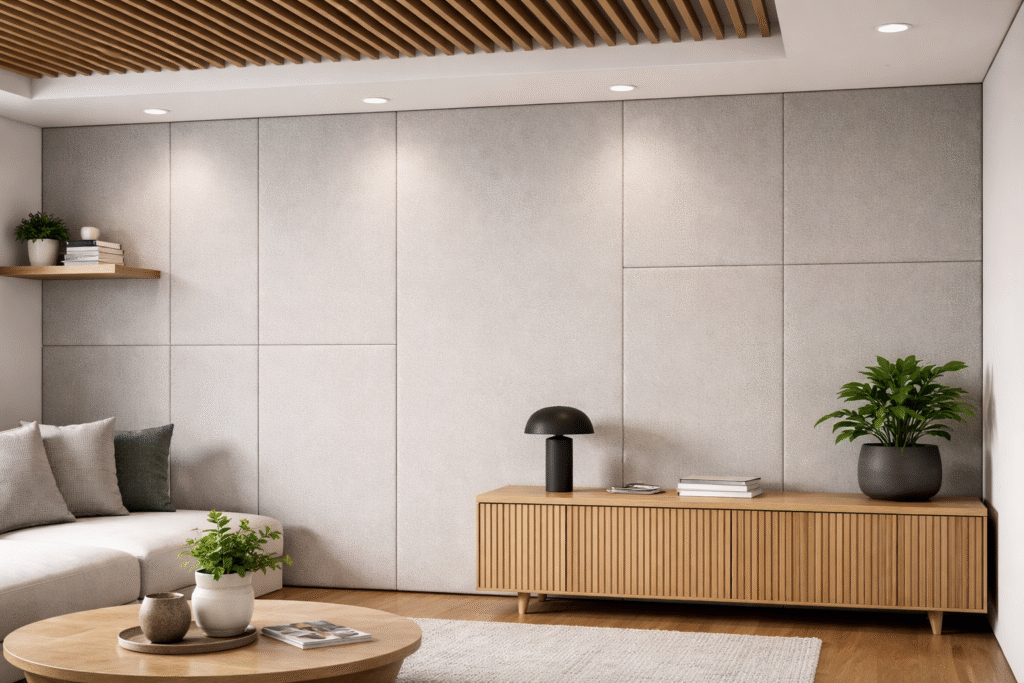
A wall that absorbs sound and looks exceptional is not a compromise — it is exactly what acoustic stretch fabric wall systems deliver. They treat a room acoustically, define its visual character, and do both without showing a single fixing, seam, or frame edge.
Stretch fabric systems have become the premium choice for commercial offices, five-star hotel function rooms, broadcast studios, conference centres, and high-end hospitality spaces. This guide covers everything: how they work, what they are made of, where they perform best, and what to look for when you specify them.
What Is an Acoustic Stretch Fabric Wall System?
An acoustic stretch fabric wall system consists of three components working together:
1. The Track System
A slim aluminium or PVC perimeter track is fixed to the wall surface. The track accepts and locks the fabric edge — creating a perfectly tensioned face with no visible fixings, wrinkles, or joins. Track profiles are available in various depths to accommodate different acoustic infill thicknesses and to create recessed or flush wall effects.
2. The Acoustic Infill
Behind the fabric face sits the absorptive core — typically 50 to 100mm of high-density mineral wool or acoustic fiberglass. The infill is placed within the track frame before the fabric is stretched over it. The type and thickness of infill material determines the system’s acoustic performance across frequency bands.
3. The Stretch Fabric
An engineered acoustic fabric with a loose enough weave to allow sound waves to pass through, yet tight enough to present a clean, upholstered finish. The fabric stretches uniformly across the track frame and locks into the perimeter channel, creating a smooth, taut surface. It is available in hundreds of colours, textures, and weave patterns.
How Does an Acoustic Stretch Fabric Wall Perform?
Acoustic performance depends primarily on the infill specification — the density, thickness, and material type of the absorptive core. Here is a general guide:
| Infill Specification | Primary Absorption Range | Typical NRC | Best Application |
| 50mm mineral wool (60 kg/m3) | Mid and high frequencies | 0.70 to 0.85 | Offices, meeting rooms |
| 75mm mineral wool (60 kg/m3) | Mid to low frequencies | 0.85 to 0.95 | Studios, conference rooms |
| 100mm mineral wool (60 kg/m3) | Broad spectrum incl. bass | 0.90 to 1.00 | Broadcast, music rooms |
| 25mm polyester fibre | High frequency only | 0.40 to 0.60 | Light commercial treatment |
For most commercial applications — offices, meeting rooms, hotel function spaces — 50 to 75mm of mineral wool delivers a Noise Reduction Coefficient (NRC) above 0.85, which is sufficient to achieve target reverberation times in the majority of room volumes.
Acoustic Stretch Fabric vs Other Wall Systems
| System Type | Acoustic Performance | Aesthetic Quality | Typical Cost |
| Stretch fabric wall | Excellent (NRC 0.70–1.00) | Excellent — seamless finish | Premium |
| Fabric-wrapped panel | Excellent (NRC 0.70–0.95) | Very good — panel edges visible | Moderate to high |
| Foam panel | Limited (high freq only) | Low — industrial look | Low |
| Wooden acoustic panel | Good (NRC 0.50–0.85) | Excellent — premium material | High |
| Perforated gypsum tile | Moderate (NRC 0.50–0.75) | Good — integrated look | Moderate |
The key advantage of stretch fabric systems over individual acoustic panels is the seamless finish. There are no visible panel edges, no grout lines, no fixings, and no gaps in the treatment surface. A single stretch fabric installation can cover an entire wall — floor to ceiling, corner to corner — in one continuous, upholstered face.
Where Acoustic Stretch Fabric Wall Systems Perform Best
Conference Centres and Ballrooms
Large function spaces demand acoustic control across a wide frequency range — speech clarity for presentations, music quality for events, and comfort for long conference sessions. Stretch fabric systems spanning full wall heights provide substantial total absorption area, and their seamless appearance suits the premium finish expected in these environments.
Broadcast and Recording Studios
Studios require precise acoustic control with zero visual compromise. Stretch fabric systems allow an acoustic designer to specify variable infill depths behind different wall zones — heavier infill on parallel walls to address standing waves, lighter treatment on diffusive surfaces. The uniform fabric face conceals this complexity completely.
Corporate Headquarters and Executive Spaces
Open-plan offices, boardrooms, and executive reception areas in Dubai’s commercial towers increasingly use stretch fabric systems as a premium alternative to fabric-wrapped panels. The seamless wall finish aligns with the architectural quality expected at this level, and the acoustic performance addresses the speech privacy and reverberation challenges inherent in hard-surfaced, glass-heavy commercial interiors.
Hotel and Resort Function Spaces
Dubai’s luxury hotel sector uses stretch fabric wall systems extensively in ballrooms, meeting suites, and pre-function areas. The systems allow the hotel’s design team to specify custom fabric colours and textures that align with the brand identity, while achieving the acoustic comfort that guests expect in premium hospitality environments.
Cinemas and Home Theatres
Cinema-quality acoustic treatment requires broad-spectrum absorption across all wall surfaces. Stretch fabric systems cover walls floor-to-ceiling and corner-to-corner with no acoustic gaps — and the fabric face is fully compatible with projector screens, speaker grilles, and lighting elements integrated within the wall plane.
Design Possibilities with Stretch Fabric Systems
Stretch fabric wall systems offer extraordinary design flexibility. Key options include:
Colour and Texture
Most manufacturers offer fabric ranges spanning hundreds of options — from neutral commercial tones to bold accent colours, from smooth weaves to pronounced textures. Custom fabric sampling allows a designer to match the wall treatment precisely to the interior colour palette.
Shape and Geometry
Track systems are not limited to rectangular frames. Curved, angled, and geometric shapes are achievable. Large-radius curves across entire walls, angled panels creating geometric relief, or irregular shapes used as feature elements — the track system adapts to the design intent.
Backlit Panels
Stretch fabric is compatible with LED backlighting installed within the track frame. Backlit stretch fabric panels create a glowing wall surface — the fabric diffuses the light source evenly across the face. This technique is widely used in hospitality and entertainment environments.
Integrated Elements
Acoustic vents, speaker grilles, power outlets, and lighting fixtures integrate cleanly into stretch fabric wall systems. Elements are cut into the fabric face and finished with compatible trim profiles — maintaining the seamless appearance of the wall surface.
Specification Guide: What to Confirm Before You Order
Acoustic Performance Data
Request the full Sound Absorption Coefficient (alpha) data for the specified infill and fabric combination, measured in a certified laboratory across the standard one-third octave bands (125Hz to 4000Hz). Confirm the NRC value. Do not rely on indicative or estimated data.
Fabric Acoustic Transparency
The fabric itself must allow sound to pass through. Request the fabric’s flow resistance data or acoustic transmission confirmation. Some decorative fabrics that appear suitable are too dense to pass sound effectively — always verify with the manufacturer.
Fire Rating
For commercial applications in the UAE, confirm that both the fabric and the infill material carry appropriate fire ratings. The fabric must meet BS 5867 or EN 13773 Class 1 minimum, and the mineral wool infill should be non-combustible (Euroclass A1 or A2). Request documentation.
Climate Compatibility
Dubai’s high humidity in coastal areas and extreme temperature cycling between air-conditioned interiors and outdoor conditions means moisture-resistant infill specification is important. Mineral wool with hydrophobic treatment performs better than standard mineral wool in these conditions. Confirm the infill’s moisture resistance rating with your supplier.
Track Depth and Wall Substrate
The track depth determines the maximum infill thickness — and therefore the low-frequency absorption capability of the system. Deeper track allows thicker infill, which improves bass absorption. Confirm the wall substrate is capable of carrying the track fixing loads, particularly on gypsum board partitions where stud spacing matters.
Installation Considerations
- Always install track on a flat, plumb wall surface — surface irregularities telegraph through the taut fabric face
- Acoustic infill must fill the cavity completely — gaps reduce performance, particularly at low frequencies
- Fabric must be stretched uniformly — uneven tension creates wrinkles that are difficult to correct after locking
- Allow the fabric to acclimatise to the room’s temperature and humidity before installation
- In high-humidity environments, leave a small ventilation gap between infill and wall surface to prevent moisture accumulation
- All cutting and joining must be performed by trained installers — fabric joins are visible in finished installations if not executed correctly
Maintenance and Longevity
Acoustic stretch fabric wall systems are designed for permanence. The aluminium track lasts indefinitely. The mineral wool infill does not degrade under normal interior conditions. The fabric face, however, can be replaced independently of the track and infill — making a full wall refresh a straightforward task.
For routine maintenance, most acoustic fabrics can be vacuum-cleaned gently with a soft brush attachment. Stain treatment should use the fabric manufacturer’s recommended method — avoid water saturation, which can compress the infill behind the face.
Working with a Specialist Supplier
Acoustic stretch fabric wall systems deliver exceptional results when specified correctly and installed by experienced teams. Poor specification — wrong infill density, inadequate fire rating, incompatible fabric weave — produces a wall that looks impressive but performs poorly.
Acoustic Panel by Akinco supplies and installs acoustic stretch fabric wall systems for commercial, hospitality, and residential projects across the UAE, with full acoustic performance data, fire-rated product documentation, and design coordination support from concept to installation.
Key Takeaways
- Acoustic stretch fabric wall systems combine a tensioned fabric face with an absorptive infill core behind a perimeter track
- They deliver seamless, floor-to-ceiling acoustic treatment with no visible panel edges, joins, or fixings
- NRC values of 0.70 to 1.00 are achievable depending on infill specification
- Best applications include conference centres, broadcast studios, corporate offices, hotel ballrooms, and home theatres
- Always confirm acoustic performance data, fire ratings, and fabric acoustic transparency before specifying
- Track systems accommodate custom shapes, backlighting, and integrated elements — making them as much a design tool as an acoustic solution